The Pythagorean theorem
In a right triangle, the two legs and the hypotenuse (the side opposite the right angle) satisfy , where is the hypotenuse. If you know any two sides, you can find the third:
- hypotenuse:
- missing leg:
Worked example: the hypotenuse
A right triangle has legs of and , shown below. Find the hypotenuse.
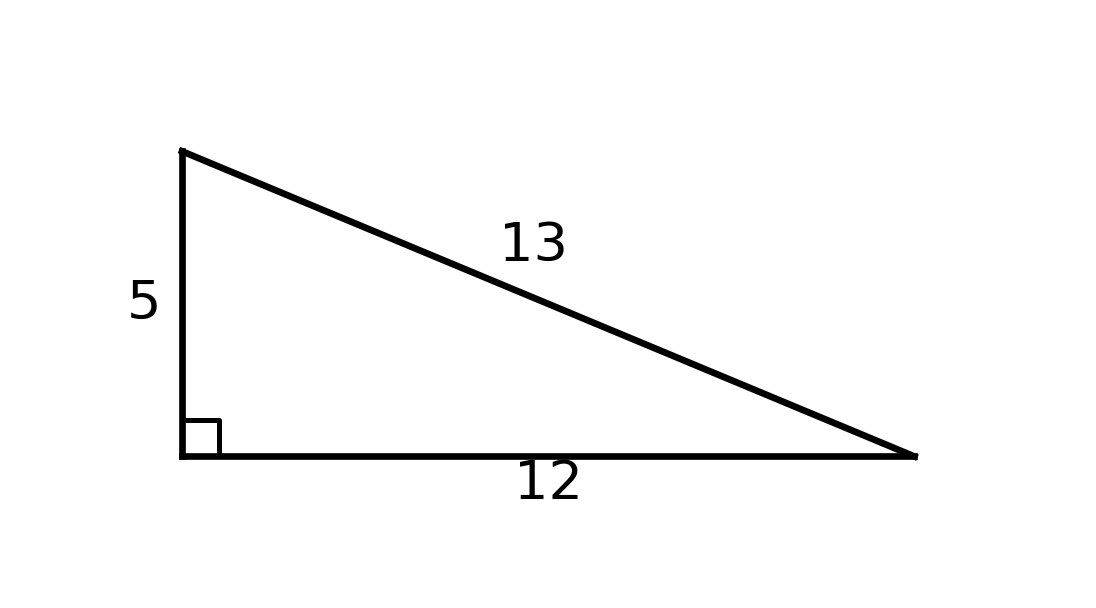
Apply the Pythagorean theorem directly: .
The ACT loves a few whole-number triples, so learn to spot them. When two sides match one of these (or a multiple of one), you can skip the calculation entirely:
| Legs | Hypotenuse |
|---|---|
Multiples count: legs of and are , so the hypotenuse is . A hypotenuse of with a leg of is , so the other leg is .
Sine, cosine, and tangent
For an acute angle in a right triangle, the three basic ratios compare sides, named relative to :
The memory aid SOH-CAH-TOA holds all three. The hypotenuse is always the longest side, and "opposite" and "adjacent" change depending on which angle you are working from. Suppose a right triangle has legs of and . The hypotenuse is . For the acute angle whose adjacent leg is , . A frequent slip is to use the opposite side for cosine, or to invert tangent, so name the sides out loud before you write the ratio.
When a problem gives only two sides, find the third with the Pythagorean theorem before computing a ratio. For example, with an opposite side of and a hypotenuse of , the adjacent side is .
Two special right triangles
The -- triangle has two equal legs, and the hypotenuse is a leg times . A leg of gives a hypotenuse of . (The same triangle is half of a square cut along its diagonal.)
The -- triangle has a hypotenuse that is twice the short leg, and the long leg is the short leg times . The short leg is opposite the angle, and the long leg is opposite the angle. With a hypotenuse of , the short leg is and the long leg is .
The classic mix-up is applying the rule to a -- triangle, where the hypotenuse is simply doubled. Check which special triangle you have before picking a rule.
The unit circle
The unit circle assigns a point to every angle . At the four axis angles, the coordinates are exact: at , at , at , and at . The standard angles , , and produce exact values worth knowing without a calculator:
You can rebuild this table from the special triangles instead of memorizing it. The sine of is the short leg over the hypotenuse, , and the cosine of is the same ratio because the sides swap roles for the other acute angle. Notice that and swap values at and .
Worked example: tan(30°)
Find .
Tangent is sine divided by cosine at that angle. Since and :
Because , any tangent value comes from the unit-circle point. For the point on the circle, .
Where this appears as a model
Real objects with only some measurements given are right triangles in disguise. A -foot ladder leaning against a wall with its base feet from the wall reaches a height of feet. The ladder, the wall, and the ground make a right triangle with the ladder as hypotenuse, so . A diagonal across a rectangular field, a ramp, and a wire attached to a pole all work the same way.
This chapter covers the right-triangle and exact-value foundation. Trigonometric identities and triangles without a right angle build directly on the sine, cosine, and tangent relationships taught here, and they are developed in their own chapter later in this Part.
Strategy checklist
- Draw the triangle and label the sides relative to the angle in question: opposite, adjacent, hypotenuse.
- Look for a triple (--, --, --, --, or a multiple) before squaring anything.
- If the angles are or and , use the special-triangle ratios instead of a calculator.
- Rewrite tangent as when only the unit-circle point is known.
- Sanity-check: the hypotenuse is the longest side, and sine and cosine of an acute angle are between and .