AP US History study guide · Chapter 58
Practice Exam 3
PART V — FULL PRACTICE EXAMS · EXAM 3
This exam follows the same format and timing as Exams 1 and 2, with stimuli, topics, and period distribution distinct from both. Complete it under timed conditions when possible. Explanations and the answer key follow the exam.
Section I, Part A: 55 Multiple-Choice Questions — 55 Minutes
| A 1973 congressional hearing transcript records testimony about secretly recorded White House conversations, with a witness confirming the existence of a taping system that could verify or contradict administration officials’ accounts of a break-in cover-up. |
Question 1
- A. Watergate
- B. The Iran-Contra affair
- C. The Teapot Dome scandal
- D. The Whiskey Ring scandal
Question 2
- A. Immediate dismissal of all charges against administration officials
- B. Increased pressure that eventually contributed to the president’s resignation
- C. A formal congressional vote of confidence in the president
- D. The permanent suspension of congressional investigative authority
Question 3
- A. This scandal was resolved without any congressional involvement
- B. The scandal had no lasting effect on public trust in government
- C. Congressional investigation and evidence gathering played a central role in uncovering abuse of presidential power
- D. Watergate concerned only minor administrative irregularities
| A practice table summarizes selected Native societies before sustained European colonization: the Southwest relied on irrigated maize agriculture and multi-story adobe settlements; the Mississippi Valley relied on intensive maize agriculture and large settled communities linked to regional exchange; the Great Basin relied on mobile subsistence strategies adapted to an arid environment; and the Northwest Coast relied on fishing, cedar use, permanent villages, and maritime trade. |
Question 4
- A. All Native societies depended on the same agricultural system
- B. Large permanent settlements existed only after European arrival
- C. Environmental conditions had little effect on Native societies
- D. Geography contributed to major regional differences in Native economic and settlement patterns
Question 5
- A. Large agricultural settlements in the Southwest and Mississippi Valley
- B. Great Basin mobility
- C. Northwest Coast maritime trade alone
- D. The absence of European livestock
Question 6
- A. Comparing regions on a shared environmental dimension
- B. Treating one regional pattern as if it described every Native society in North America
- C. Connecting subsistence strategies to geography
- D. Recognizing that Native societies changed over time
| An 1859 newspaper account describes an armed raid on a federal arsenal in Virginia, led by a white abolitionist hoping to arm enslaved people for a wider uprising, ending in his capture and the deaths of several raiders. |
Question 7
- A. The Stono Rebellion
- B. Nat Turner’s Rebellion
- C. John Brown’s raid on Harpers Ferry
- D. Shays’s Rebellion
Question 8
- A. The event produced immediate national consensus condemning the raid
- B. Southern states responded with increased support for abolition
- C. Northern abolitionists universally condemned the raid as counterproductive
- D. Some antislavery northerners praised Brown as a martyr, while many other northerners condemned the raid; white southerners widely interpreted the attack as evidence that antislavery politics threatened their security
Question 9
- A. By the late 1850s, sectional distrust had deepened to the point where the same event confirmed opposite fears in each region
- B. Sectional tensions had fully resolved by 1859
- C. This event was the sole cause of the Civil War
- D. Armed abolitionist action was common and unremarkable by 1859
| A 1670s French account describes fur traders living for months among an Algonquian-speaking nation, learning the language, marrying into local families, and relying entirely on Native trapping and guiding knowledge to move goods toward Montreal. |
Question 10
- A. France sent larger numbers of settlers than Spain to North America
- B. French colonization depended on small numbers of traders building kinship and commercial ties rather than large-scale conquest and settlement
- C. French colonists avoided all contact with Native nations
- D. France focused exclusively on plantation agriculture
Question 11
- A. Fulfilling a religious requirement imposed by French missionaries
- B. Avoiding taxation under French colonial law
- C. Building durable economic and diplomatic alliances essential to the fur trade’s success
- D. Establishing permanent French land claims through inheritance
Question 12
- A. All European powers used identical colonization strategies
- B. France prioritized large-scale settlement over trade relationships
- C. This trading relationship had no lasting economic significance
- D. Different European powers pursued colonization through varied strategies suited to their specific goals and resources
| A December 1941 radio bulletin interrupts regular programming to announce a surprise attack on American naval forces in the Pacific, with initial casualty estimates and a promise of further updates as information becomes available. |
Question 13
- A. The attack on Pearl Harbor
- B. The invasion of Normandy
- C. The bombing of Hiroshima
- D. The German invasion of Poland
Question 14
- A. Continued American neutrality in the Pacific theater
- B. An American declaration of war on Japan, followed by German and Italian declarations of war on the United States
- C. Immediate Japanese surrender
- D. A formal alliance between the United States and Japan
Question 15
- A. The United States had already been at war with Japan for several years before this event
- B. Radio played no significant role in informing the public about wartime events
- C. A sudden military attack, rather than a gradual policy shift alone, brought the United States fully into the war
- D. This attack had no connection to earlier American Lend-Lease policy
| A 1754 newspaper cartoon shows a snake cut into separate segments, each labeled for a colony or region, beneath the words JOIN, or DIE. |
Question 16
- A. War of 1812
- B. Mexican-American War
- C. Civil War
- D. Seven Years’ War in North America
Question 17
- A. Greater intercolonial cooperation for defense and imperial conflict
- B. Immediate independence from Britain
- C. Abolition of colonial assemblies
- D. Permanent alliance with France
Question 18
- A. Colonial unity began only after independence was declared
- B. Efforts at intercolonial cooperation appeared before the Revolution, although colonial political unity remained limited
- C. The colonies already functioned as one centralized nation in 1754
- D. The Albany Congress immediately created a binding national government
| An 1869 photograph caption describes two locomotives meeting at a ceremonial point in Utah Territory, with workers from two different railroad companies posing together as officials prepare to drive a final ceremonial spike. |
Question 19
- A. The founding of the first American railroad company
- B. The invention of the steam locomotive
- C. The completion of the transcontinental railroad
- D. The nationalization of the American railroad system
Question 20
- A. Direct federal ownership and construction of the railroad
- B. A treaty with Britain regulating railroad construction
- C. State-level taxation exclusively funding the project
- D. Federal land grants and subsidies supporting private railroad construction
Question 21
- A. Federal policy actively organized and subsidized western economic development rather than leaving it purely to private initiative
- B. Railroad construction occurred entirely without government involvement
- C. This railroad had no effect on Native nations whose land it crossed
- D. Western economic development was primarily driven by individual homesteaders alone
| A December 1955 flyer distributed in Montgomery, Alabama, urges Black residents to avoid city buses following a woman’s arrest for refusing to give up her seat, announcing a one-day protest that would extend into a sustained boycott. |
Question 22
- A. The Birmingham campaign
- B. The Montgomery Bus Boycott
- C. The Selma voting rights campaign
- D. The Freedom Rides
Question 23
- A. Federal troop deployment to enforce the boycott
- B. A Supreme Court order mandating the boycott’s continuation
- C. Sustained community logistics such as carpool networks and continuous fundraising
- D. Direct funding from the federal government
Question 24
- A. The boycott succeeded within its first week with no further organizing required
- B. This boycott had no connection to later civil rights campaigns
- C. National leaders alone, without local participation, sustained the boycott
- D. Sustained local organizing, not a single dramatic incident alone, determined the boycott’s ultimate success
| An 1815 newspaper account celebrates an American military victory at New Orleans, describing celebrations in multiple cities despite the battle occurring after a peace treaty had already been signed in Europe. |
Question 25
- A. The War of 1812
- B. The Mexican-American War
- C. The Quasi-War with France
- D. The American Revolution
Question 26
- A. It proved that the war had been fought entirely over Louisiana Territory
- B. It gave the war a triumphant conclusion in American memory regardless of its actual strategic necessity
- C. It ended all future American military conflicts with Britain
- D. It caused immediate British recognition of American naval supremacy
Question 27
- A. The Democratic-Republican Party
- B. The Whig Party
- C. The Federalist Party
- D. The Anti-Federalist movement
| ORIGINAL PRACTICE ADAPTATION, PRO-INTERVENTION NEWSPAPER RHETORIC, 1898. A fictionalized editorial describes Spanish repression in Cuba in sensational terms and urges American intervention on humanitarian grounds. The passage is designed to test yellow journalism and mixed motives for war and is not a verbatim newspaper editorial. |
Question 28
- A. Careful, verified war reporting
- B. Government censorship preventing any coverage of Cuba
- C. Uniform newspaper opposition to American intervention
- D. Sensationalized journalism that inflamed public opinion toward military intervention
Question 29
- A. Humanitarian framing intertwined with strategic and commercial interest in the Caribbean
- B. Purely religious motivation with no strategic component
- C. Congressional mandate with no public opinion influence
- D. Direct Spanish invitation for American intervention
Question 30
- A. The war began with no domestic public support
- B. Public opinion, shaped by sensationalized press coverage, contributed to pressure for war alongside strategic and economic motives
- C. Newspapers played no role in shaping American entry into the war
- D. This editorial reflects the official position of the Spanish government
| A 1739 South Carolina colonial report describes an armed uprising of enslaved people near the Stono River, who seized weapons from a store, killed several colonists, and attempted to reach Spanish Florida before being intercepted by the colonial militia. |
Question 31
- A. Universal passivity among enslaved populations before the Revolution
- B. Resistance that occurred exclusively through legal channels
- C. Organized, armed resistance aimed at escaping to territory offering freedom
- D. Cooperation between enslaved people and colonial slaveholders against Spanish Florida
Question 32
- A. Immediate abolition of slavery in South Carolina
- B. Expanded legal rights for enslaved people
- C. Reduced colonial militia funding
- D. Stricter slave codes restricting enslaved people’s movement, assembly, and access to weapons
Question 33
- A. Enslaved people actively resisted bondage well before the Revolutionary era, using whatever routes to freedom seemed available
- B. Armed resistance to slavery began only during the Civil War
- C. Colonial slave societies faced no internal security concerns
- D. This was the only recorded instance of enslaved resistance before 1776
Question 34
- A. Spanish and British colonies maintained no contact with one another
- B. Imperial rivalries between Spain and Britain created real, if risky, opportunities that enslaved people sometimes tried to exploit
- C. Florida offered no meaningful alternative to enslaved people in South Carolina
- D. Colonial borders had no bearing on strategies of enslaved resistance
| An 1868 Freedmen’s Bureau report describes a newly built schoolhouse in rural Georgia serving both children and adults, noting that many students walk several miles daily and that demand for enrollment far exceeds available teachers and supplies. |
Question 35
- A. Federal indifference toward freedpeople’s welfare
- B. The immediate achievement of full educational equality in the South
- C. Formerly enslaved people’s strong demand for education despite limited resources
- D. Southern state governments’ enthusiastic funding of Black education
Question 36
- A. The Freedmen’s Bureau had no meaningful effect on Black communities
- B. Educational access for freedpeople was already equal to that of white Southerners
- C. Demand for Black education declined rapidly after emancipation
- D. Black communities built real institutions and pursued opportunity actively rather than passively receiving assistance
Question 37
- A. Historians increasingly emphasize Black agency and institution-building rather than treating freedpeople only as passive recipients of federal policy
- B. Historians universally describe Reconstruction as a period of Black passivity
- C. This report has no connection to broader interpretive debates about Reconstruction
- D. Educational institutions receive no attention in Reconstruction scholarship
| An October 1957 news report describes American scientists reacting with alarm to a Soviet satellite now orbiting Earth, warning that the achievement suggests a dangerous gap in American missile and space technology. |
Question 38
- A. The Cuban Missile Crisis
- B. The launch of Sputnik
- C. The first American moon landing
- D. The Berlin Airlift
Question 39
- A. Immediate American withdrawal from the space race
- B. A formal treaty banning satellite technology
- C. Increased federal investment in science and technology education and space program funding
- D. Reduced federal spending on defense-related research
Question 40
- A. The Cold War involved no competition outside of direct military conflict
- B. This event had no connection to broader American anxiety about Soviet capability
- C. Space technology developed entirely independent of Cold War competition
- D. Cold War competition extended into technological and scientific arenas beyond direct military confrontation
| An 1820 congressional debate transcript records a representative warning that admitting Missouri as a slave state without any counterbalancing measure will permanently upset the sectional balance in the Senate. |
Question 41
- A. The Missouri Compromise
- B. The Compromise of 1850
- C. The Kansas-Nebraska Act
- D. The Wilmot Proviso
Question 42
- A. The Electoral College’s method of selecting the president
- B. Equal state representation in the Senate regardless of population
- C. The House of Representatives’ population-based apportionment
- D. The Supreme Court’s power of judicial review
Question 43
- A. Sectional balance in the Senate was never a significant political concern
- B. This debate marked the first time slavery had been discussed in Congress
- C. Territorial admission repeatedly forced Congress to confront the unresolved balance between free and slave states
- D. The admission of new states had no connection to slavery politics
| An 1876 army officer’s after-action report describes a cavalry regiment’s total defeat near the Little Bighorn River, noting that combined Lakota, Cheyenne, and allied forces vastly outnumbered the attacking column. |
Question 44
- A. The Battle of New Orleans
- B. Bleeding Kansas
- C. The Sand Creek Massacre
- D. The Battle of the Little Bighorn
Question 45
- A. Intensified U.S. military campaigns against Plains nations rather than a lasting change in federal policy
- B. Federal recognition of Lakota sovereignty over the Black Hills
- C. Immediate U.S. military withdrawal from the Great Plains
- D. A formal treaty ending all conflict with Plains nations
Question 46
- A. Native nations never won any military engagements against U.S. forces
- B. Native military victories, even significant ones, did not reverse the broader trajectory of federal policy toward confinement and control
- C. This defeat ended organized U.S. military campaigns on the Plains entirely
- D. The battle had no connection to broader federal Indian policy
| A 1786 letter from a Massachusetts farmer describes joining armed neighbors to block a county courthouse, preventing judges from hearing foreclosure cases against debt-burdened farmers struggling under high state taxes and scarce currency. |
Question 47
- A. The Whiskey Rebellion
- B. Bacon’s Rebellion
- C. Shays’s Rebellion
- D. The Stono Rebellion
Question 48
- A. The immediate ratification of the Bill of Rights
- B. The founding of the first political parties
- C. Renewed British military intervention in Massachusetts
- D. Growing elite support for replacing the Articles of Confederation with a stronger national government
Question 49
- A. Economic distress and weak central authority combined to expose real limits in the Articles of Confederation
- B. The Confederation government successfully addressed all economic grievances
- C. State governments had no role in responding to civil unrest
- D. This event had no connection to later constitutional reform
| A September 2001 emergency broadcast describes commercial aircraft deliberately crashed into buildings in New York and Washington, with government officials ordering the grounding of all domestic flights as the scale of the attack becomes clear. |
Question 50
- A. The Oklahoma City bombing
- B. The September 11 attacks
- C. Pearl Harbor
- D. The Cuban Missile Crisis
Question 51
- A. The abolition of the Central Intelligence Agency
- B. A formal declaration of war against a specific nation-state
- C. The creation of the Department of Homeland Security and expanded surveillance authority
- D. The permanent closure of American airports
Question 52
- A. American national security policy remained completely unchanged after this event
- B. This event had no connection to subsequent American military action abroad
- C. Domestic security policy was unaffected by this attack
- D. A single dramatic attack could reorient national security priorities as fundamentally as a major foreign policy shift
| A 1926 literary review praises a new collection of poetry from a Harlem-based writer, noting its unflinching portrayal of Black urban life and its innovative use of rhythms drawn from blues and jazz music. |
Question 53
- A. The Harlem Renaissance
- B. The Beat Generation
- C. The Lost Generation
- D. The Southern Agrarian movement
Question 54
- A. The movement rejected any connection to popular music
- B. Artists drew on distinctly Black cultural and musical traditions to create new literary forms
- C. Harlem-based writers avoided any reference to urban life
- D. This movement had no connection to broader currents in American culture
Question 55
- A. Racial segregation had ended by the time of this review
- B. The Harlem Renaissance had no connection to the Great Migration
- C. Significant Black cultural achievement occurred even as segregation and discrimination continued largely unchanged nationally
- D. This literary movement occurred in complete isolation from Black communities elsewhere
Section I, Part B: Short-Answer Questions — 40 Minutes
SHORT ANSWER: QUESTION 1
Secondary sources.
| Secondary Source A, original historical interpretation for this practice exam: American intervention in Cuba grew from widespread outrage over Spanish repression and sympathy for Cuban independence. Humanitarian concern was politically powerful because reports of reconcentration, civilian suffering, and violence made continued neutrality difficult to defend. Secondary Source B, original historical interpretation for this practice exam: Humanitarian language cannot by itself explain the Spanish-American War. Strategic interest in the Caribbean, expanding commercial ties, naval thinking, and sensational press coverage helped make intervention attractive to political leaders and the public. |
a) Briefly explain ONE piece of historical evidence that could be used to support Source A.
b) Briefly explain ONE piece of historical evidence that could be used to support Source B.
c) Briefly explain ONE additional piece of evidence relevant to evaluating the causes of the war that is not already stated in either source.
SHORT ANSWER: QUESTION 2
Primary source.
| Primary source, adapted from George Washington to Henry Lee, October 31, 1786: Writing during unrest in Massachusetts, Washington argues that the disturbances reveal a dangerous lack of effective governmental power. He fears that if public authority cannot enforce law and preserve stability, the reputation and survival of republican government will be placed at risk. |
a) Briefly explain Washington’s point of view regarding the condition of government under the Confederation.
b) Briefly explain ONE specific historical development from 1781 to 1789 that helps explain the concern expressed in the source.
c) Briefly explain ONE way the Massachusetts unrest strengthened the movement for a new national political framework.
SHORT ANSWER: QUESTION 3
Non-text source.
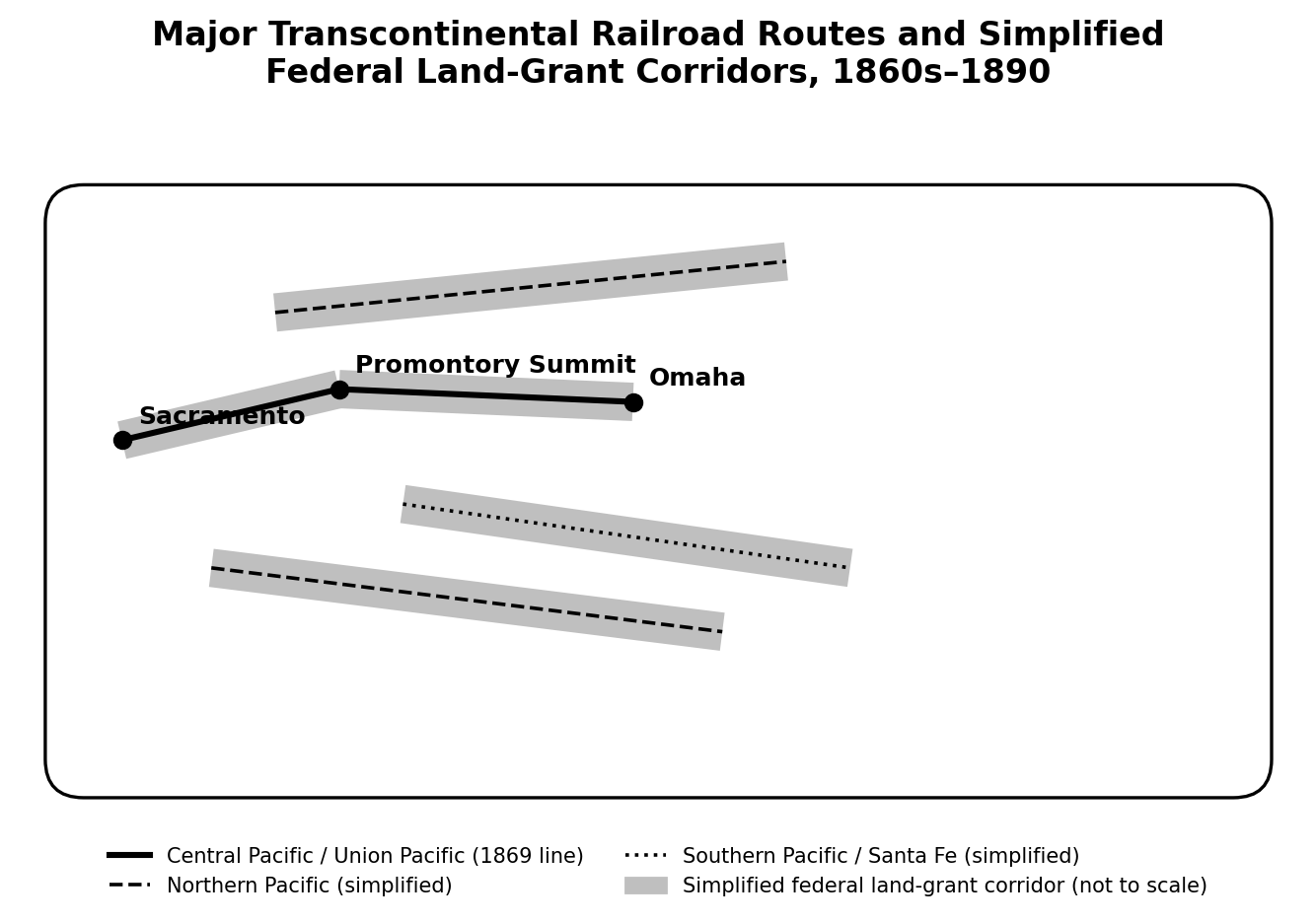
| Caption: Major transcontinental railroad routes and simplified federal land-grant corridors, 1860s–1890. Source: Original practice map based on federal railroad land-grant legislation and public-domain federal mapping; simplified for historical reasoning. |
a) Briefly explain ONE specific historical factor that helps account for the federal land grants shown on the map.
b) Briefly explain ONE specific effect these railroad routes had on Native nations whose territory they crossed. c) Briefly explain ONE way this data connects to a broader pattern of federal economic policy in the late nineteenth century.
Section II, Part A: Document-Based Question — 60 Minutes
Evaluate the extent to which domestic anticommunism between 1947 and 1954 reflected genuine national security concerns rather than political opportunism.
Document 1 (1947)
| Adapted from President Harry S. Truman’s Executive Order 9835, establishing a federal employee loyalty program. Federal agencies were directed to investigate employees when reasonable grounds raised doubts about loyalty, including evidence of membership in organizations designated as totalitarian, fascist, communist, or subversive. |
Document 2 (1948)
| Adapted from Whittaker Chambers’s testimony before the House Committee on Un-American Activities. Chambers alleges that Alger Hiss had participated in a secret Communist network and had provided government documents for transmission to Soviet intelligence. Hiss denied the accusation and was later convicted of perjury rather than espionage. |
Document 3 (1950)
| Adapted from Senator Joseph McCarthy’s public speech claiming that Communists had penetrated the State Department. He presents the problem as a hidden internal threat and asserts that he possesses names or evidence of disloyal officials, while the number and documentation behind his claims shift across later statements. |
Document 4 (1951)
| Adapted from the federal prosecution’s case in United States v. Julius and Ethel Rosenberg. Prosecutors argued that Julius Rosenberg helped organize an espionage network that transmitted military and atomic-related information to Soviet agents and that Ethel participated in the conspiracy. The case became a powerful symbol of fears about Soviet espionage. |
Document 5 (1947)
| Adapted from the Hollywood studio executives’ Waldorf Statement, issued after the Hollywood Ten controversy. Major studios announced that the cited employees would be suspended or dismissed and that the companies would not knowingly employ Communists, helping establish a private-industry blacklist tied to political affiliation and congressional investigation. |
Document 6 (1954)
| Adapted from Joseph N. Welch’s televised challenge to McCarthy during the Army-McCarthy hearings, after the senator attacked a young lawyer connected to Welch’s firm. Welch condemns the personal accusation and asks the senator to recognize the human damage caused by unsupported public charges. |
Document 7 (1954)
| Adapted from the U.S. Senate resolution censuring Joseph McCarthy. The Senate condemned McCarthy’s conduct toward a Senate committee and toward colleagues who investigated him, concluding that his behavior was contrary to Senate traditions and obstructed legitimate institutional processes. |
Section II, Part B: Long Essay Question — 40 Minutes
From Reconstruction through the end of the twentieth century, the federal government repeatedly faced demands to protect individual rights against state laws, private discrimination, and government action. Constitutional amendments, court decisions, federal legislation, executive action, and national-security policy changed the reach of federal protection over time.
Evaluate the extent to which the federal government’s role in protecting individual rights changed from 1865 to 2001.
You may focus on one or more developments within this period. You are not expected to discuss every rights issue or every decade.
Exam 3 Answer Key: Multiple Choice
| 1 | A | 2 | B | 3 | C | 4 | D | 5 | A |
| 6 | B | 7 | C | 8 | D | 9 | A | 10 | B |
| 11 | C | 12 | D | 13 | A | 14 | B | 15 | C |
| 16 | D | 17 | A | 18 | B | 19 | C | 20 | D |
| 21 | A | 22 | B | 23 | C | 24 | D | 25 | A |
| 26 | B | 27 | C | 28 | D | 29 | A | 30 | B |
| 31 | C | 32 | D | 33 | A | 34 | B | 35 | C |
| 36 | D | 37 | A | 38 | B | 39 | C | 40 | D |
| 41 | A | 42 | B | 43 | C | 44 | D | 45 | A |
| 46 | B | 47 | C | 48 | D | 49 | A | 50 | B |
| 51 | C | 52 | D | 53 | A | 54 | B | 55 | C |
Exam 3 SAQ Model Answers
Q1a: Spanish reconcentration policies in Cuba and reports of civilian suffering support Source A. American sympathy for Cuban independence made humanitarian intervention a genuine part of public and congressional pressure for war.
Q1b: The expansion of U.S. commercial interests in Cuba, naval-strategic thinking, and sensational press coverage support Source B. The explosion of the USS Maine intensified pressure, even though the exact cause of the explosion was not established at the time.
Q1c: The Teller Amendment is useful because it publicly disclaimed permanent U.S. annexation of Cuba, while the later Platt Amendment and acquisition of overseas territories reveal that strategic power also shaped the war’s consequences.
Q2a: Washington sees the unrest as evidence that government under the Confederation lacks enough effective power to maintain order and national credibility. His perspective reflects elite anxiety that republican government could fail if public authority remained too weak.
Q2b: Shays’s Rebellion itself grew from postwar debt, taxes, scarce money, and foreclosure pressures in Massachusetts. At the national level, the Articles left Congress without an independent taxing power and with limited capacity to respond to interstate or domestic crises.
Q2c: The unrest strengthened arguments for the Philadelphia Convention and a national government with stronger taxing, military, and enforcement powers. Federalists later used the disorders as evidence that the Articles needed replacement.
Q3a: Congress and the federal government used land grants and subsidies because transcontinental railroads were expensive, strategically important, and expected to accelerate western settlement, commerce, and national integration.
Q3b: Railroad construction crossed Native lands, accelerated settler migration and resource extraction, supported military logistics, and contributed to destruction of bison herds and pressure on Native sovereignty.
Q3c: The map fits a broader pattern of active federal economic development in the West. Pacific Railway subsidies, the Homestead Act, land policy, and federal surveys show that western growth was not simply a private-market process.
Exam 3 DBQ: Full Seven-Point Scoring Package
MODEL THESIS
Domestic anticommunism from 1947 to 1954 grew from genuine security concerns, including Soviet espionage, the Soviet atomic breakthrough, communist victory in China, and the Korean War. Those fears also created an environment in which politicians, employers, and investigators could expand accusations beyond proven threats. By the early 1950s, McCarthyism and blacklisting show that political opportunism and institutional self-protection had become major forces alongside real security concerns.
CONTEXTUALIZATION
World War II ended with rapid deterioration of the U.S.-Soviet alliance. Soviet influence in Eastern Europe, the Truman Doctrine, the Berlin crisis, the Soviet atomic test, the Chinese Revolution, and the Korean War made communist expansion appear to be a global security challenge before McCarthy reached national prominence.
DOCUMENT USE
Document 1 supports the reality of strategic fear; Document 2 shows a serious espionage allegation involving a former official; Document 3 demonstrates unsupported political accusation; Document 4 shows a major espionage prosecution; Document 5 shows private blacklisting under political pressure; Document 6 demonstrates McCarthy’s methods being challenged publicly; Document 7 shows institutional correction through Senate censure.
OUTSIDE EVIDENCE
Use the Truman Loyalty Program, HUAC and the Hollywood Ten, the Smith Act, the McCarran Internal Security Act, or loyalty oaths. Do not use the Rosenberg case as outside evidence because Document 4 already contains it.
SOURCING EXAMPLES
For Document 1, a presidential order governing federal employment shows that security concerns were embedded in national policy before McCarthyism became a mass political phenomenon. For Document 3, McCarthy was speaking to a public audience and gained political power from dramatic claims, so the speech is useful for analyzing political incentives as well as fear. For Document 5, studios were responding to congressional pressure and reputational risk, so their employment policy shows how anticommunism could spread without a criminal conviction. For Document 6, a nationally televised hearing changed the audience from committee members to millions of viewers, making McCarthy’s methods themselves part of the public evidence.
COMPLEX UNDERSTANDING ROUTE
A strong answer can explain the interaction between real and exaggerated threats. Proven espionage and Cold War crises made anticommunist claims more credible, while weak evidentiary standards and partisan incentives allowed the fear to spread beyond genuine security cases. Institutional correction in 1954 limited McCarthy but did not immediately end loyalty programs, blacklisting, or anticommunist politics.
Exam 3 LEQ: Full Six-Point Scoring Package
MODEL THESIS
The federal role in protecting individual rights expanded substantially from 1865 to 2001, but the change was uneven and repeatedly contested. Reconstruction amendments created national constitutional protections, yet federal retreat allowed segregation and disfranchisement to grow. Mid-twentieth-century courts, Congress, and presidents later used federal power more aggressively against racial discrimination and to protect additional rights, while later disputes over privacy, equality, crime, and national security showed that federal power could both protect and restrict individual liberty.
CONTEXTUALIZATION
Before the Civil War, most civil and political rights were defined and enforced primarily by states, and the Supreme Court had offered little federal protection against slavery or racial exclusion. The Civil War and emancipation created the conditions for constitutional changes that made national citizenship and federal enforcement central questions.
EVIDENCE
Strong evidence includes the Thirteenth, Fourteenth, and Fifteenth Amendments; Reconstruction civil-rights and Enforcement Acts; federal retreat after Reconstruction; Plessy v. Ferguson; anti-lynching campaigns; Brown v. Board; Executive Order 9981; the Civil Rights Act of 1964; Voting Rights Act of 1965; federal enforcement in school desegregation; Title IX; Roe v. Wade if used carefully as a constitutional-rights example; affirmative-action debates; disability-rights legislation; or post-September 11 security measures in 2001 that raised civil-liberties questions.
REASONING
Use continuity and change to compare the weak and inconsistent enforcement of Reconstruction-era rights with the stronger federal enforcement that developed during the twentieth-century civil-rights era. A causation route can explain how social movements, litigation, electoral change, and national crises pushed the federal government toward new forms of rights protection or restriction.
COMPLEX UNDERSTANDING ROUTE
The best answers should separate constitutional authority from actual enforcement and should recognize that federal power did not move in only one direction. The same national government that expanded voting and civil-rights protections could also limit liberties during war or security crises. Judicial, legislative, and executive protection also developed at different speeds.
ACCEPTABLE NARROW ROUTES
A student may center the essay on racial citizenship, voting rights, gender and privacy, or the tension between national security and civil liberty, provided that the response establishes meaningful change across time and does not treat one isolated episode as the whole answer.
Exam 3: Full Multiple-Choice Answer Explanations
1. Answer A. The 1973 testimony about a White House taping system belongs to the Watergate investigation. The tapes became crucial because they could confirm or contradict presidential and staff accounts of the cover-up.
2. Answer B. Disclosure of the taping system intensified legal and congressional pressure. The struggle over access to the tapes and the evidence they contained helped produce the crisis that ended with Nixon’s resignation.
3. Answer C. Watergate demonstrates the importance of congressional investigation, courts, journalism, and evidence in checking presidential abuse. The scandal was not resolved internally by the executive branch.
4. Answer D. The table shows that Native societies developed very different economies and settlement systems in response to regional environments. Geography influenced adaptation without producing one universal pattern.
5. Answer A. Large agricultural communities in the Southwest and Mississippi Valley directly contradict the claim that all Native societies were small and mobile. Permanent settlement existed long before sustained European colonization.
6. Answer B. A regional example cannot stand in for the entire continent. The table should be used comparatively, with attention to environment, economy, and political organization in different places.
7. Answer C. The 1859 raid on the federal arsenal at Harpers Ferry was led by John Brown. His plan was to seize weapons and encourage a wider antislavery uprising.
8. Answer D. Northern reactions were divided, but some abolitionists honored Brown as a martyr while white southerners widely saw the raid as proof that antislavery politics threatened their safety. The contrast deepened sectional fear.
9. Answer A. Harpers Ferry shows how sectional distrust had become self-reinforcing by the late 1850s. The same event could confirm opposite regional narratives about aggression and danger.
10. Answer B. French colonization depended heavily on small trading populations, kinship ties, and Native commercial and diplomatic networks. That pattern differed from the larger conquest and settler systems associated with parts of Spanish America.
11. Answer C. Intermarriage could create durable kinship relationships that supported the fur trade and diplomacy. These relationships mattered economically and politically in the French-Native borderlands.
12. Answer D. European empires pursued different strategies based on goals, resources, geography, and Native relationships. No single model describes French, Spanish, Dutch, and English colonization.
13. Answer A. The surprise attack described is Pearl Harbor on December 7, 1941. It brought a direct military assault on U.S. territory and forces into the center of American public life.
14. Answer B. The United States declared war on Japan, and Germany and Italy soon declared war on the United States. The result was full U.S. entry into the global war.
15. Answer C. American policy had already moved away from strict neutrality through rearmament and aid, but Pearl Harbor produced the decisive formal entry into war. The source captures that sudden shift.
16. Answer D. The Join, or Die cartoon first appeared during the Seven Years’ War era as Benjamin Franklin promoted greater colonial cooperation in the face of French and Native military pressure.
17. Answer A. The segmented snake urged colonies to coordinate and avoid acting separately. The image promoted collective defense and political cooperation, not immediate independence from Britain.
18. Answer B. Intercolonial cooperation existed before the Revolution, but it was limited and inconsistent. The cartoon is useful because it shows an early effort to build unity before a national government existed.
19. Answer C. The meeting of the Union Pacific and Central Pacific lines in Utah marked completion of the first transcontinental railroad in 1869.
20. Answer D. Federal land grants and subsidies under the Pacific Railway Acts helped private railroad companies finance construction. The project demonstrates active federal support for infrastructure.
21. Answer A. Western development was not simply the work of isolated settlers. Land grants, railroad subsidies, military policy, surveys, and homestead legislation made the federal government a major organizer of expansion.
22. Answer B. The flyer refers to the Montgomery Bus Boycott, launched after Rosa Parks’s arrest in December 1955.
23. Answer C. The boycott lasted because local organizers built carpools, fundraising networks, church coordination, and sustained participation. A one-day protest alone could not have maintained pressure for more than a year.
24. Answer D. Montgomery illustrates the central role of local organizing in civil-rights success. Famous individuals mattered, but durable institutions and community participation turned an incident into a movement.
25. Answer A. The Battle of New Orleans occurred at the end of the War of 1812, after the Treaty of Ghent had been signed but before news had crossed the Atlantic.
26. Answer B. The victory gave Americans a triumphant memory of a war whose military outcome had been mixed. The symbolic effect was greater than the battle’s strategic role in negotiating the treaty.
27. Answer C. The Battle of New Orleans strengthened a triumphant public memory of the War of 1812. The Federalist Party’s decline reflected the broader wartime aftermath, especially political damage from the party’s opposition to the war and the Hartford Convention. New Orleans contributed to that atmosphere; it was not the sole cause.
28. Answer D. The sensationalized editorial illustrates yellow journalism, which used dramatic and sometimes poorly verified reports to build public outrage over events in Cuba.
29. Answer A. Humanitarian concern coexisted with strategic and commercial interests in the Caribbean. The best interpretation allows several motives to operate at the same time.
30. Answer B. Sensational press coverage contributed to the climate for intervention, but it was one factor among Cuban rebellion, Spanish policy, strategic calculations, commercial interests, and the Maine crisis.
31. Answer C. The Stono Rebellion was an organized armed revolt by enslaved people in South Carolina who tried to move toward Spanish Florida, where freedom had been offered under certain conditions.
32. Answer D. South Carolina tightened slave controls after Stono, restricting movement, assembly, education, and access to weapons. Colonial slave societies responded to resistance by expanding surveillance and coercion.
33. Answer A. Stono demonstrates that enslaved people resisted bondage long before the Revolutionary era. Resistance could include escape, work slowdowns, cultural survival, petitions, and armed rebellion.
34. Answer B. Spanish-British rivalry created possible escape routes. Enslaved people understood imperial borders and sometimes tried to use them strategically, showing that Atlantic politics affected individual choices.
35. Answer C. The Freedmen’s Bureau school shows the intense demand for education after emancipation. Formerly enslaved people treated literacy and schooling as tools of autonomy, citizenship, and family advancement.
36. Answer D. Freedpeople built churches, schools, political organizations, businesses, and family networks. Reconstruction gains therefore came from Black institution-building as well as federal policy.
37. Answer A. Modern Reconstruction scholarship emphasizes Black agency and the democratic possibilities created after slavery. That interpretation rejects older portrayals of freedpeople as passive or incapable political actors.
38. Answer B. The 1957 Soviet satellite was Sputnik. Its launch shocked many Americans because it suggested Soviet strength in rocketry and science.
39. Answer C. Sputnik accelerated federal investment in science, mathematics, defense research, and the space program, including the National Defense Education Act and expansion of NASA-era priorities.
40. Answer D. The space race shows that Cold War competition extended beyond armies and diplomacy into technology, education, scientific prestige, and missile capability.
41. Answer A. The 1820 debate produced the Missouri Compromise, which admitted Missouri as a slave state and Maine as a free state while restricting slavery in much of the remaining Louisiana Purchase territory north of latitude 36 degrees 30 minutes.
42. Answer B. Equal representation of states in the Senate made sectional balance politically important. Admitting a new slave or free state could shift the Senate even when population patterns in the House were different.
43. Answer C. Territorial growth repeatedly reopened the political question of slavery’s expansion. Missouri was an early major example of a conflict that returned with Texas, the Mexican Cession, Kansas, and later western territories.
44. Answer D. The 1876 defeat described is the Battle of the Little Bighorn, where Lakota, Cheyenne, and allied forces destroyed Custer’s immediate command.
45. Answer A. The U.S. response was not recognition of permanent Native control. Federal military pressure intensified and helped force many Plains peoples onto reservations.
46. Answer B. Native forces could win major battles, but those victories did not reverse the long-term combination of federal military power, settler expansion, railroad growth, and reservation policy.
47. Answer C. The 1786 courthouse-closing movement was Shays’s Rebellion, a protest rooted in debt, taxation, foreclosure, and postwar economic distress in Massachusetts.
48. Answer D. The rebellion alarmed many national leaders and strengthened support for replacing the Articles with a government that had greater fiscal and coercive capacity.
49. Answer A. The episode exposed real weaknesses in the Confederation system, especially national financial limits and the difficulty of responding to interstate or domestic crises. State policy still mattered, so the explanation should not blame the Articles alone.
50. Answer B. The emergency broadcast describes the September 11 attacks of 2001.
51. Answer C. The attacks contributed to creation of the Department of Homeland Security and major expansion of federal security and surveillance policy, including the USA PATRIOT Act.
52. Answer D. September 11 dramatically reordered U.S. national-security priorities and contributed to wars in Afghanistan and Iraq, expanded homeland security, and renewed debate over executive power and civil liberties.
53. Answer A. The description fits the Harlem Renaissance, a flowering of Black literature, music, visual art, and intellectual life centered strongly in Harlem but connected to the wider Great Migration and national Black culture.
54. Answer B. Harlem Renaissance artists often drew on blues, jazz, vernacular speech, migration experience, and Black historical memory. The movement did not reject popular Black culture.
55. Answer C. The movement demonstrates major cultural achievement under conditions of continuing segregation and discrimination. Cultural innovation did not mean that racial inequality had disappeared.