The two adaptive Math modules
The math section adjusts to you. Understanding exactly how it adjusts, and which questions decide that adjustment, turns the format from a mystery into a plan.
The introduction to this part sketched the adaptive format; this lesson makes it concrete, because the way the test is built has direct consequences for how you should move through it. The Digital SAT is multistage adaptive: Module 1 performance determines the difficulty mix of Module 2, and the final section score is based on performance across both modules using the scoring model. Knowing precisely where that decision happens, and what it turns on, lets you spend your effort where it changes your score the most. None of this is secret; it is published structure, and a top scorer simply uses it on purpose.
Two 35-minute Math modules: 22 questions each
The math section runs 70 minutes and is split into two equally timed modules of 35 minutes each. Each module holds 22 questions, for 44 in all, and within each module exactly two are unscored pretest items the test is quietly trying out, indistinguishable from the rest. The practical reading of that is simple: since you cannot tell which is which, treat every question as if it counts. Within a module, roughly three-quarters of the questions are multiple-choice and the rest are student-produced responses; the exact interface and placement are controlled by Bluebook, so learn the entry rules rather than trying to predict where one will appear. Across the module, questions are arranged from easier to harder, but pretest items can land anywhere and any single question may not match its position, so keep reading each one rather than judging it by where it sits.
Module 1 performance routes the difficulty of Module 2
The adaptivity works at the level of the module, not the individual question, so the test does not get harder with each right answer the way some computer tests do. Module 1 contains a mix of difficulty levels, and performance in it determines whether Module 2 arrives with a higher-difficulty or lower-difficulty mix. That single routing decision is the entire adaptive mechanism.
Your Math score reflects performance across both modules together, not a fixed ceiling determined solely by which version of Module 2 you receive. Because pretest questions are not identified within a module, treat every item as live and worth your full accuracy. The useful strategy follows directly from this: protect accuracy in Module 1, since it is worth points directly and shapes the difficulty of everything that follows, and do not try to diagnose your route while the clock is running.
Protect Module 1 accuracy without overchecking
Put those two facts together and a clear priority falls out: in an adaptive test, there is no throwaway question in the first module. Every item there is helping decide whether you are routed toward the harder-difficulty module or the easier-difficulty one. Performance across the whole module determines the route: not a published cutoff, and not brilliance on a few hard ones, so steady, careful accuracy across all of it is what shapes your route. Once the module is submitted, that decision is made; nothing is gained by trying to calculate or replay it. This reframes your goal for the opening module: lock in the questions you can get. Module 1 matters twice strategically: its scored items contribute to your section score, and performance across the module determines the Module 2 difficulty mix. Do not assign a fixed point value to individual questions: College Board uses Item Response Theory, so the score depends on the pattern of responses and characteristics of the questions, including difficulty.
Protect Module 1 accuracy without overchecking
Module 1 contains a mix of difficulty levels; it is the test's measurement of where you stand.
Module 1 performance determines whether Module 2 arrives with a higher-difficulty or lower-difficulty mix.
Your score reflects performance across both modules together, not a ceiling fixed solely by which version of Module 2 you receive.
Protect the questions you can answer accurately before spending disproportionate time on one difficult problem.
Mark questions for review only with a specific return plan
Because the test adapts only between modules, within a module you have complete freedom: you can move back and forth among its 22 questions, change answers, and use the built-in mark-for-review flag to tag any question you want to revisit before the module closes. Use this freedom deliberately. Make a first pass that banks every question you can answer confidently and quickly, flagging anything that would cost you minutes, then return to the flagged ones with the time you have saved. What you cannot do is return to a module once it closes, so finish your review inside the module, never counting on a later chance.
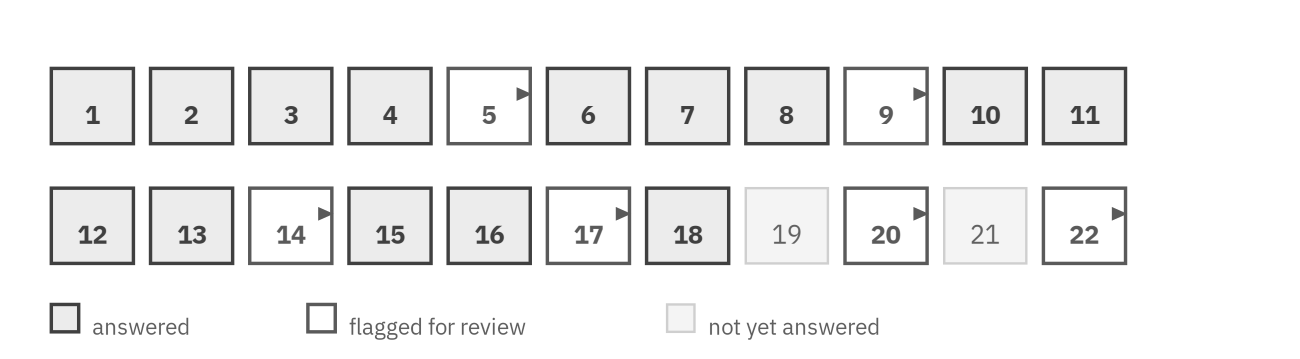
Figure 1. Within a module you move freely: bank the questions you know, flag the slow ones, and return to them with your remaining time.
Bank time on earlier questions for the harder end of the module
Twenty-two questions in 35 minutes is about 95 seconds each on average, a diagnostic figure, not a per-question rule. An early routine question can take thirty seconds; a layered one near the end can rightly take two or three minutes. The lesson on pacing and triage turns that unevenness into a full system, including exactly when to flag a stubborn question and move on.
Answer every item before the module locks
One rule overrides all the pacing arithmetic: the Digital SAT has no penalty for a wrong answer. A blank and a wrong answer score the same, zero, so a guess can only help. Never leave a question unreached. Late in a module the move is a plausible answer on anything unfinished, not a blank. The pacing lesson builds the specific end-of-module routine for this.
Two-module strategy checklist
Treat Module 1 as both scored work and the routing stage; protect accuracy without trying to infer the route from individual questions.
First pass: answer every question you can do quickly; flag the slow ones and move on.
Second pass: return to flagged questions with your remaining time.
Spend unevenly: ninety-five seconds is only the average; never let one problem swallow the module.
Answer all 22 questions before the module closes: a guess scores the same as a blank at worst, and better at best.
Finish your review inside the module: once it closes, you cannot return.
Adaptive modules: summary
The math section is two timed modules of 22 questions. Module 1 contains a mix of difficulty levels, and how you do on it determines whether Module 2 arrives with a higher-difficulty or lower-difficulty mix; your score reflects performance across both modules together. Exactly two questions in each module are unscored pretest items that Bluebook never identifies, so the only workable approach is to treat every question as live and worth full effort. That makes early, even accuracy the highest priority. Once a module is submitted, that routing is decided, so there is nothing to gain by second-guessing it. Within a module you move freely, using mark-for-review to flag anything slow; the pacing lesson turns that freedom into a full pacing system. Operate the format on purpose, and it stops being a mystery and becomes a plan that secures the score your mathematics has earned.