Back-solving and strategic test values
When a question is hard to solve forward, you can often work it backward instead: test the answers it gives you, or invent your own numbers and make the abstract concrete.
Solving forward, setting up the algebra and grinding to the answer, is the method you are taught, and on many questions it is the right one. But it is not the only one, and on a timed test it is sometimes the slowest and most error-prone. Most Math questions are multiple choice, so answer choices can sometimes be used as information rather than treated only as endpoints. These two moves, back-solving and plugging in, turn problems that resist algebra into simple arithmetic. The judgment of which to use is quick, and worth making automatic.
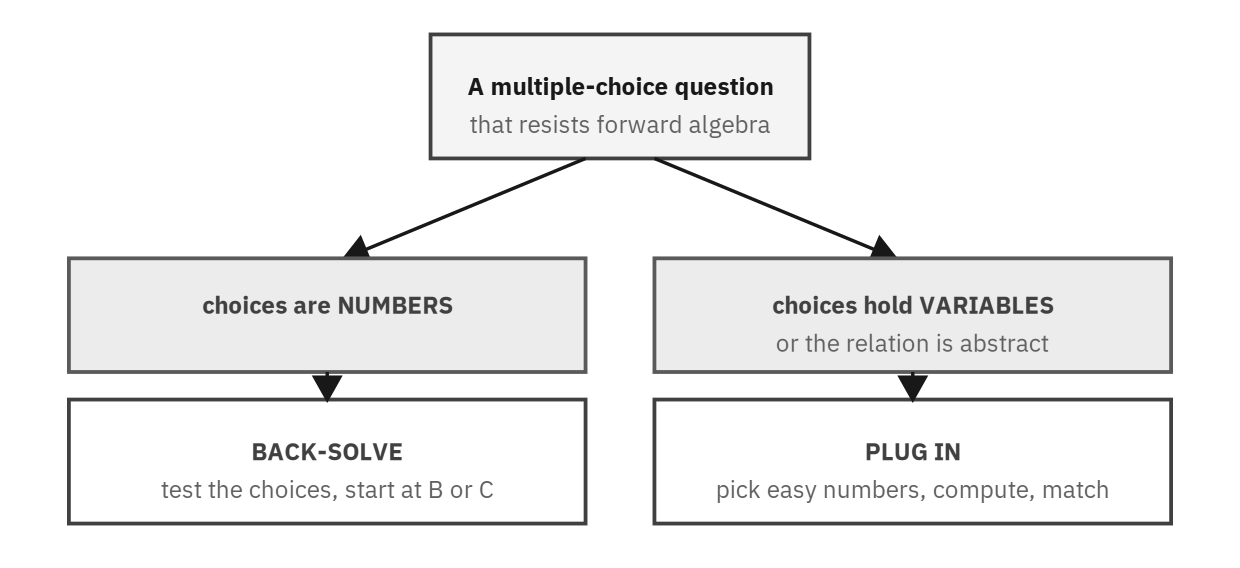
Figure 1. The substitution decision: number choices invite back-solving; variable or abstract choices invite plugging in.
Back-solve by testing answer choices
When the answer choices are numbers and the question is awkward to solve directly, do not solve it, test it. One of the four choices is the answer, so substitute them into the question and see which one works. When numeric choices are ordered, start with a middle value, B or C. If it is too large or too small, that result may tell you which direction to test next. Back-solving trades a hard forward derivation for a few quick checks, each of which is just arithmetic you can do confidently.
Worked example: back-solve an awkward equation. Find if , with choices 4, 7, 10, 13.
Rather than cross-multiply and solve, test the middle choice : left , right .
Both sides equal 7, so is the answer, confirmed with two small divisions and no algebra to slip on.
Use back-solving when answer choices simplify the equation
Back-solving shines exactly where forward algebra is fragile: equations tangled with fractions or nested parentheses, problems that would need the quadratic formula, and word problems where translating to an equation is the hard part. In a word problem, you can often skip the equation entirely; take a numeric choice, read it back into the story, and check whether the story holds. The choice that makes the words come out true is the answer.
Worked example: back-solve a word problem. A number plus 8 equals three times the number, decreased by 4. What is the number? Choices: 4, 5, 6, 8.
Test by reading it into the sentence: the number plus 8 is 14; three times the number decreased by 4 is .
The two sides match, so the number is 6: no equation written, just the story checked against a choice.
Choose valid test values to evaluate relationships
The other move applies when the answer choices contain variables, or when the question describes an abstract relationship with no numbers at all. Here you supply the numbers yourself: pick easy values for the variables, work the question to a concrete target number, then test each choice with the same values and keep the one that produces your target. A question about becomes a question about 5, and matching a number is far easier than matching an expression. Choose values that are easy but not special: avoid 0 and 1, which make too many things equal, and avoid numbers already in the problem.
Worked example: plug in for an equivalent expression. Which expression equals for ? Choices: , , , .
Pick . The original is , so your target is 8.
Now test the choices at : matches, while , , and do not.
So the answer is , found by matching a single number instead of factoring.
Use test values only when one valid case can answer the claim
Two question types are tailor-made for plugging in. Percent problems with no starting amount become easy if you start from 100, since percentages of 100 are effortless to track through increases and decreases. And must-be-true questions (“which of the following is always even,” “which must be negative”) yield to testing concrete cases: pick numbers that fit the condition, eliminate any choice that comes out false, and test a second set of numbers to break ties among the survivors.
Worked example: plug in for a percent question. A price is increased by 25 percent and then decreased by 20 percent. The final price is what percent of the original?
Start from 100. A 25 percent increase gives 125; a 20 percent decrease takes 20 percent of 125, which is 25, leaving .
The final price is 100: the same as the original, so the answer is 100 percent. The two changes happen to cancel, which the numbers reveal at once.
Know when back-solving or test values prove, disprove, or only suggest
Two habits keep substitution reliable. First, when plugging in, if two choices both produce your target number, you picked values that did not separate them: simply try a second set of numbers, and the true answer will survive while the impostor falls away. Second, always answer the question that was asked: back-solving tells you which choice is correct, but if the question asks for a quantity built from that value, take the extra step. Used with these cautions, substitution is not a shortcut that sacrifices rigor; it is a different, often faster, path to the same certain answer.
Choose between algebra, back-solving, and plugging in
Numeric choices, awkward to solve: back-solve; start at a middle choice.
Variables in the choices, or a fully abstract relation: plug in easy numbers.
Percent with no given amount: start from 100.
Must-be-true: test concrete cases, then a second case to break ties.
Always: confirm you are reporting the quantity the question actually asked for.
Back-solving and test values: summary
When a multiple-choice question resists clean forward algebra, substitution gives you a faster road. If the choices are numbers, back-solve: test them, starting from a middle value, until the question is satisfied. If the choices hold variables or the relationship is abstract, plug in easy numbers, compute a target, and match it; start percent problems from 100 and use concrete cases to screen must-be-true choices, eliminating any that fail, then confirm the survivor with a structural reason rather than more cases alone. Pick values that are simple but not special, break ties with a second case, and always report the quantity actually asked for. These are not evasions of the mathematics; they are a different, often quicker, way to arrive at the same right answer with less room to slip.
In the practice set, compare the substitution route with the direct method before solving, and choose the shorter valid path.