Part II: Advanced Math
Advanced Math is close in size to Algebra and centers on nonlinear expressions, equations, and functions. Unlike a linear relationship, a nonlinear relationship does not have a constant rate of change. Quadratic, exponential, polynomial, rational, radical, and absolute-value structures make up the core of this domain.
The skill that carried you through Algebra carries you through here without modification: choose the form that reveals what you need. A quadratic can be written three different ways, and each one places a different feature in plain sight: where the curve crosses zero, where it turns, where it meets the vertical axis. An expression can be factored or expanded, and the two forms answer different questions. A function can be read forward or backward. None of that habit is new; only the relationships it acts on have started to bend.
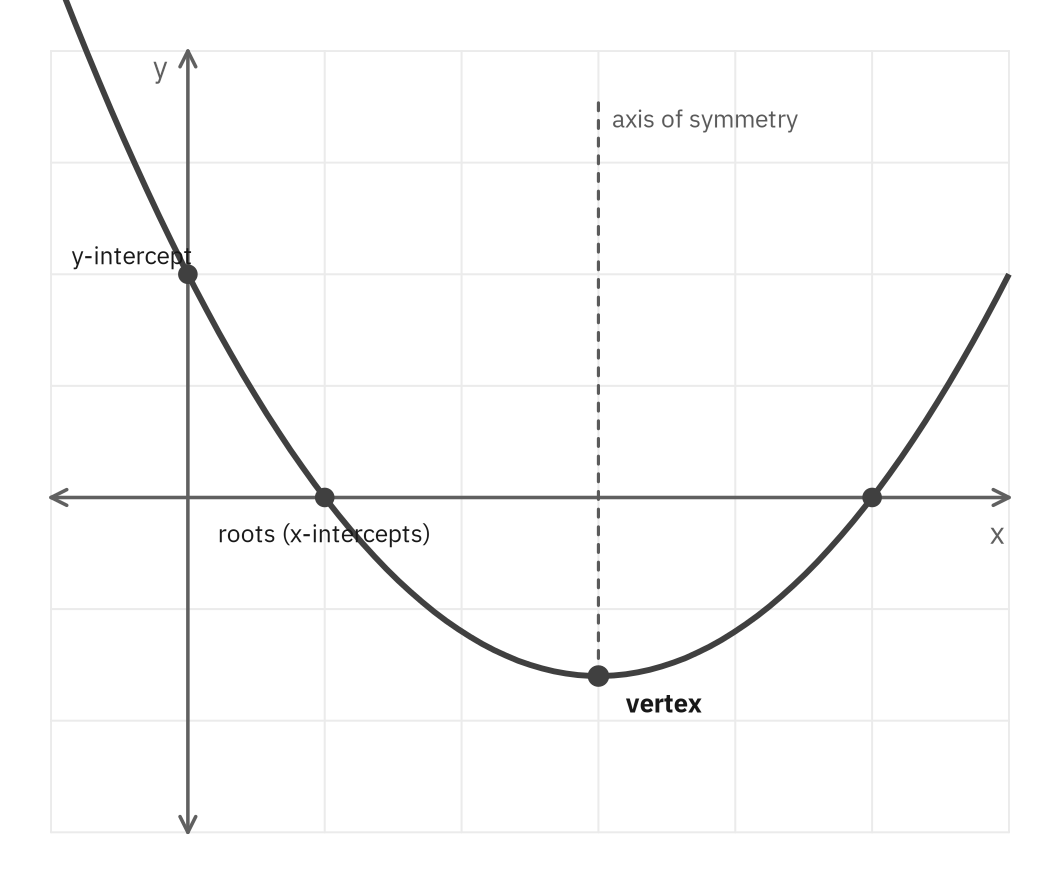
Figure 1. The parabola, the recurring object of this domain: roots, vertex, intercept, and the symmetry that ties them together.
Quadratics deserve particular attention because roots, vertex, y-intercept, and symmetry can all be read from different representations. Learn to read a parabola for its landmarks: its roots where it crosses the horizontal axis, its vertex where it turns, its intercept on the vertical axis, and the axis of symmetry that mirrors one side onto the other. A large share of the domain's questions reduce to pointing at the feature you were asked for. The same equation holds all of these at once, and, as in Algebra, the efficient route is to choose the representation that exposes the requested feature.
The questions to keep in mind shift only slightly from the last domain. What does this form reveal, and what does it keep hidden? What stays genuinely the same when I rewrite an expression, and what merely looks different on the page? And is the question asking for a value, a root, a turning point, or a behavior as the input grows large? Naming which of these is on the table keeps the algebra aimed at the right target instead of producing something true but unasked.
In this domain
Equivalent expressions, rewriting to reveal: factoring, expanding, and choosing the form that answers the question rather than fighting the one you were handed.
Nonlinear functions: notation, transformations, composition, and inverses: inputs and outputs, domain, and reading a function in both directions, in symbols and in context.
Nonlinear functions: quadratic forms and features: the three forms and the feature each surfaces, the discriminant, and the graph read as evidence.
Nonlinear equations in one variable: radicals and rational expressions, and the extra solutions that rewriting can introduce and that must be checked.
Exponential growth, where change compounds instead of adding, and how it overtakes any linear rate given enough room.
If Algebra taught you to read a straight relationship no matter which form it takes, this domain asks the same of a bending one. The objects are richer and the graphs more interesting, but the move is the one you already trust: find the form that makes the answer visible, then read it off. The first skill is rewriting an expression into an equivalent form that makes the requested feature easier to identify.
Equivalent expressions
The same expression can be written many ways without changing its value. The goal is to choose the form that makes the requested feature easiest to read.
Two expressions are equivalent when they produce the same value for every input; they are the same quantity written two different ways. Rewriting changes the form without changing the value. A question that asks "which of the following is equivalent to..." is really asking whether you can move fluently among those forms, and a harder question hands you one form and is answerable only after you change it into another. So the skill to build here is two-directional fluency, expanding a product into a sum and factoring a sum back into a product, together with an eye for which direction the question rewards.
Combine polynomials by adding and subtracting like terms
Before any expanding or factoring, two polynomials can simply be added or subtracted, term matched to term. Like terms, ones with the same variable raised to the same power, combine; unlike terms sit side by side unchanged. A subtraction is the one place a sign slip hides: distribute the minus across every term of the polynomial being subtracted before combining anything.
Add and subtract and :
Sum:
Difference:
The sum matches the , , and constant terms straight across. The difference first flips every sign in the second polynomial (), then combines. The most common error is subtracting only the first term and leaving the rest added.
Expand polynomial products
Expanding means carrying out every multiplication until nothing is left in parentheses. Each term in the first factor multiplies each term in the second, and you collect like terms at the end. For two binomials this is the familiar four-product pattern.
Worked example: expand
Multiply every term in the first factor by every term in the second:
The two middle products combined; nothing was added or removed, only multiplied out.
There is a picture underneath this that makes the bookkeeping visible. A product of two lengths is an area, so a product like is the area of a square whose side is , and splitting that square into pieces shows exactly which terms appear.
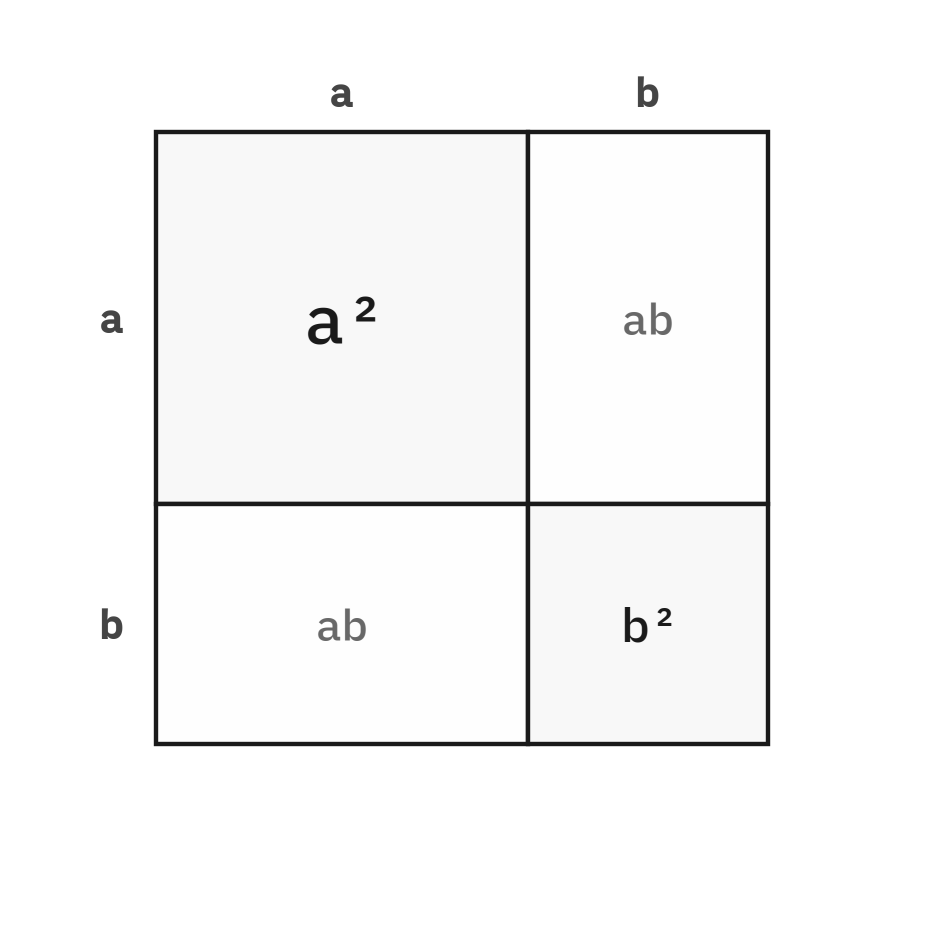
Figure 2. Why : the square of side splits into one , one , and two rectangles.
Recognize difference-of-squares and perfect-square products
A few products appear so often that recognizing them instantly, in either direction, saves real time. They are not separate facts to memorize so much as three shapes to recognize.
Three products to recognize in both directions
Square of a sum: .
Square of a difference: .
Sum times difference: , the middle terms cancel.
The third is worth dwelling on, because its middle terms cancel and leave a clean difference of two squares. Read backward, it is one of the most useful factoring patterns there is.
Worked example: two quick expansions
.
.
, no middle term survives.
The most common mistake with a squared binomial is to square each piece and stop. is not ; the middle term is always there, and in Figure 2 it is the two rectangles.
Factor polynomial expressions
Factoring reverses expansion: it takes a sum and writes it as a product. This is the more demanding direction, since it requires searching for the pieces rather than multiplying them together. A factored expression reveals features that a sum's expanded form does not show directly. The first move is to pull out any common factor shared by every term.
Worked example: pull out the common factor
. Both terms share .
Always check for a common factor first; it simplifies everything that follows, and a question that asks to factor completely will demand it.
Use difference-of-squares and perfect-square factoring patterns
Beyond the common factor, a small set of patterns covers the great majority of what the test asks. Learning to recognize the shape of an expression tells you which one to reach for.
A difference of squares, two perfect squares with a minus between them, factors into a sum times a difference, the third product above read backward.
Worked example: difference of squares
is , so
.
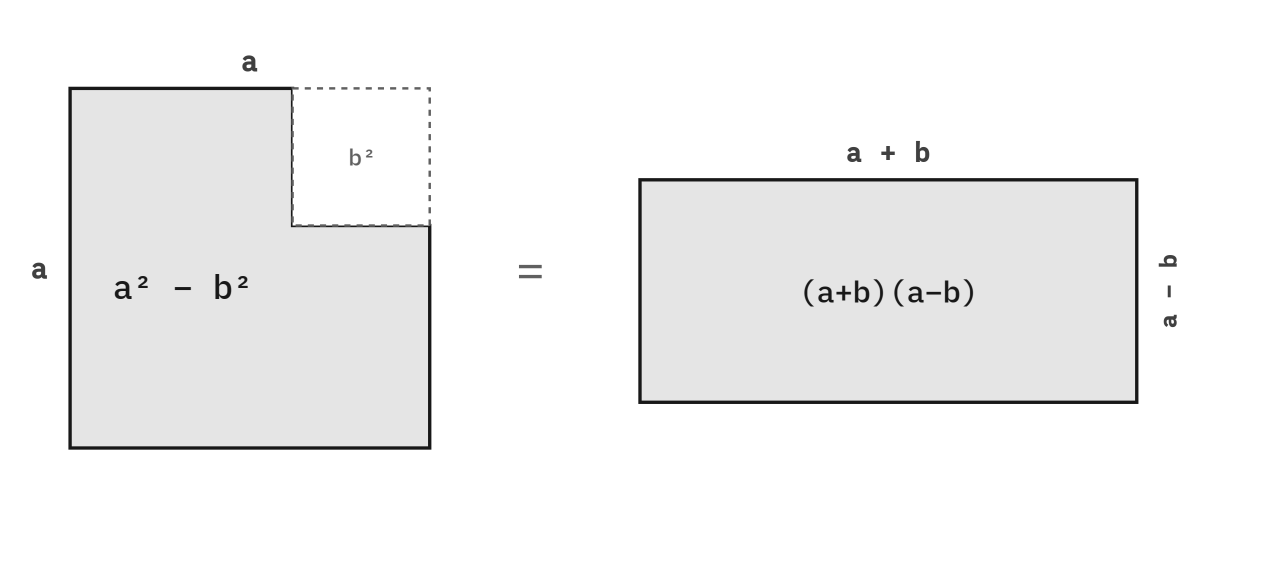
Figure 3. A difference of squares is a rectangle: removing a corner from an square leaves an by region.
A perfect-square trinomial is the expansion of a squared binomial, recognizable because its first and last terms are squares and its middle term is twice the product of their roots.
Worked example: perfect-square trinomial
has and , and the middle , the signature of a square.
.
For a general trinomial , you are looking for two numbers that multiply to and add to . The area picture shows why: the two numbers are the side lengths added onto , so their product fills the constant corner and their sum builds the middle term.
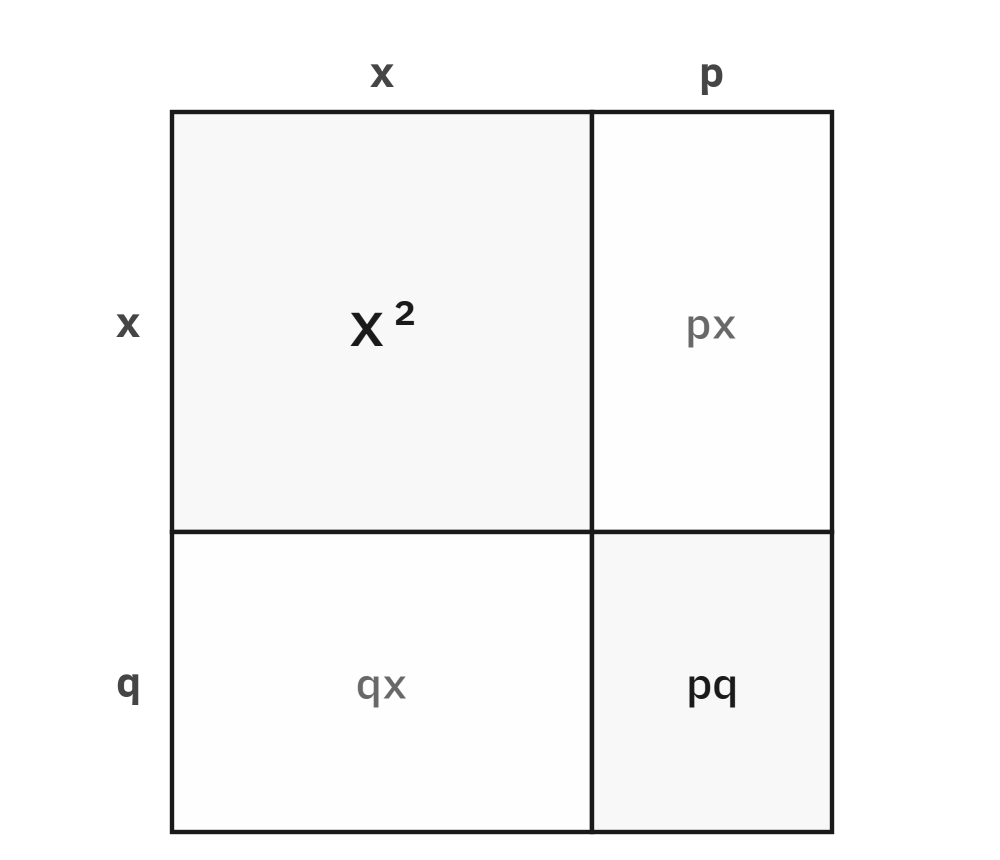
Figure 4. Factoring : the two numbers fill the corner (their product is ) and the side strips (their sum is ).
Worked example: a trinomial with leading coefficient 1
: find two numbers multiplying to 12 and adding to 7, namely 3 and 4.
.
When the leading coefficient is not 1, the same idea runs through a short detour. To factor , find two numbers multiplying to and adding to , split the middle term using them, and factor by grouping.
Worked example: a trinomial with a leading coefficient
: here , and two numbers multiplying to 6 and adding to 7 are 6 and 1.
Split the middle term and group:
That last step, grouping, is a pattern in its own right, the tool for expressions with four terms. Group the terms in pairs, factor each pair, and if a common binomial appears, factor it out.
Worked example: factoring by grouping
. Group and factor each pair:
The shared is the signal that grouping was the right move.
Whenever you factor, expand your answer in your head as a check. If it does not return the original expression, a sign or a pairing is off.
Use factored form to identify zeros
Here is the payoff that makes factoring worth the effort. A product equals zero only when one of its factors equals zero, the zero-product idea. So the moment an expression is factored, the values that make it zero are sitting in plain view.
Worked example: reading the zeros
is hard to read as written, but factored it opens up:
A product is zero only if a factor is, so or .
The factored form did not just simplify the expression, it handed over the answer. This is exactly why the quadratics ahead lean on factoring so heavily.
Simplify rational expressions and preserve excluded values
A rational expression is a ratio of polynomials, and the way to simplify one is almost always the same: factor the top and bottom, then cancel what they share. A factor can be cancelled only when it appears in both, and one piece of care travels with it: the values that would make the original denominator zero are excluded from the start, even if cancelling appears to remove them.
Worked example: simplify a rational expression
. Factor both:
The shared cancels, leaving
, valid for and .
The restriction stays attached even though the factor is gone, because the original expression was never defined there.
On the graph, the two excluded values behave differently, and the difference is the cancelled factor. At , the factor cancelled, so the function is simply undefined at one point: a hole, a single missing dot on an otherwise ordinary curve. At , the factor never cancelled; the denominator still reaches zero there while the numerator does not, so the function shoots toward positive or negative infinity on either side: a vertical asymptote, not a hole. A hole comes from a factor shared by top and bottom; an asymptote comes from a factor the denominator has alone.
Multiplying and dividing rational expressions follows the same factor-first habit: factor everything, then cancel across the product (and remember that dividing means multiplying by the reciprocal). Adding and subtracting them, as with ordinary fractions, requires a common denominator first.
Worked example: combine over a common denominator
. The common denominator is ; rewrite the first term:
.
Once the denominators match, only the numerators are added.
Rewrite an expression into the form that exposes the requested feature
All of this fluency serves one judgment: deciding which form a given question wants. If a question asks where an expression equals zero, the factored form puts the answer on the surface. If it asks for the value when the input is zero, the expanded form shows the constant term directly. If it asks for the largest or smallest value, a third form (the completed square, coming in the quadratics section) is the one to reach for. The expressions are all equal; the skill is reading the question, naming the feature it wants, and turning the expression to the form that displays that feature without a fight.
A short symmetric trick is worth keeping in your pocket as well. When a question gives you a sum like and asks about , do not solve for . Square the given expression: the cross term collapses to the constant 2, and the target appears with a number attached.
Chapter summary
Equivalent expressions are one quantity written many ways, and fluency means moving between those forms at will: expanding a product into a sum, factoring a sum back into a product, and simplifying a ratio by factoring and cancelling. The patterns (common factor, difference of squares, perfect square, the two-number trinomial, and grouping) are a short list you come to recognize on sight. And the reason any of it matters is that the right form shows the answer: factored form reveals the zeros, expanded form reveals the constant, and the requested feature usually signals which one to reach for.