Linear inequalities in one and two variables
A linear inequality describes a set of allowed values or points, and its boundaries determine which values are included.
An inequality makes a different kind of claim than an equation. An equation says a variable equals one value; an inequality says it lives somewhere in a range. So the answer is no longer a single number but a set (a stretch of the number line, or a region of the plane) and the work divides into two parts: solving, which mostly mirrors what you already do with equations, and reading the result correctly, including the one rule that genuinely differs and the edges that are easy to misread.
Interpret a linear inequality as a solution set
Solving a linear inequality uses the same inverse operations as solving an equation, and most of the time the steps are identical. Solving gives , but that is not one value; it is every value from 3 onward. The single new thing to attend to is the edge. Because the relation is "greater than or equal to," the boundary value 3 belongs to the set, drawn as a filled endpoint. A strict would leave that edge open, excluded.
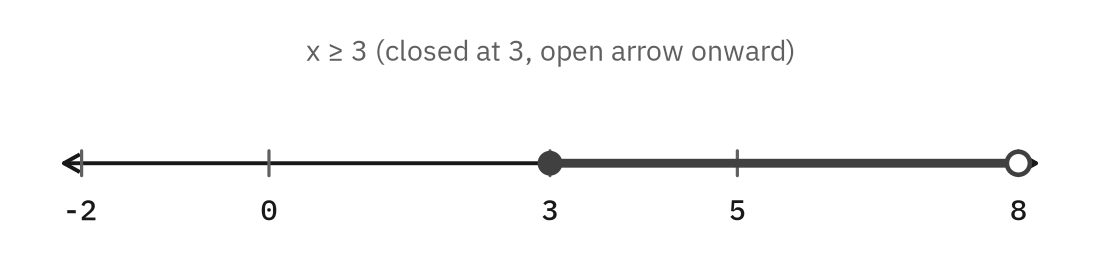
Figure 1. An inequality is a region of the number line. A closed (filled) endpoint includes the boundary; a strict inequality leaves it open. The picture shows both kinds of endpoint: filled at 3 and open at 8.
Translating "at most" and "at least"
Word problems most often hand you an inequality in disguise, through a phrase rather than a symbol, and two phrases account for nearly all of them. "At most" sets a ceiling: the quantity can be that value or anything below it, so it becomes . "At least" sets a floor: the quantity can be that value or anything above it, so it becomes . In both cases the boundary word itself belongs to the allowed set; neither translates to a strict inequality.
Worked: translate a spending limit. A club can spend no more than $480 on shirts that cost $18 each, plus a $30 delivery fee. If is the number of shirts, which inequality models the situation?
"No more than" is a ceiling, so it becomes . The total cost is the per-shirt charge plus the fixed fee:
Reading "no more than" as a strict instead of is the common slip; the limit itself is always an allowed value, never an excluded one.
Reverse the inequality sign after multiplying or dividing by a negative
There is exactly one rule that an inequality obeys and an equation does not: multiplying or dividing both sides by a negative number reverses the direction of the inequality. This is not an arbitrary convention to memorize; it follows from what negating does. Multiplying by a negative reflects the number line through zero, and reflection turns "greater" into "less." If 3 is bigger than 1, then is smaller than .
Worked: solve .
Subtract 4 from both sides: an ordinary step, no flip:
Now divide by , and because the divisor is negative, the direction reverses:
The flip happens only at the moment you divide by the negative; the earlier subtraction left the direction untouched.
The most common slip in the entire topic is doing this arithmetic correctly but forgetting to turn the sign. A quick guard: after solving, test one value from your answer in the original inequality. If is supposed to be a solution, check that it actually satisfies the starting line, a five-second test that catches a missed flip every time.
Optional enrichment: unknown-sign multiplication in inequalities
The flip rule has a sharp consequence: you may not multiply or divide both sides by a quantity whose sign you do not know. If you multiply through by a variable that might be positive or might be negative, you cannot tell whether to reverse the inequality, so the step is simply not legal as written. This is why an inequality with a variable in a denominator cannot be "cross-multiplied" the way an equation can: clearing the denominator silently assumes a sign you have not established.
The honest route, when it comes up, is to split into cases, one where the unknown quantity is positive and one where it is negative, and solve each separately, then combine. The point to carry, even when the full case-work is more than a given question needs, is the alarm itself: multiplying an inequality by something whose sign is unknown is not a harmless step.
Solve compound inequalities with AND and OR
Conditions often arrive in pairs, and how they join changes the answer. An "and" keeps only the values satisfying both, the overlap of the two regions. An "or" keeps anything satisfying either, their union. The "and" case has a compact three-part form, , which you solve by doing the same operation to all three pieces at once.
Worked: solve .
Subtract 3 from all three parts:
Divide all three by 2 (positive, so no flip):
The solution is the band of values greater than and at most 3; open at the left edge, closed at the right.
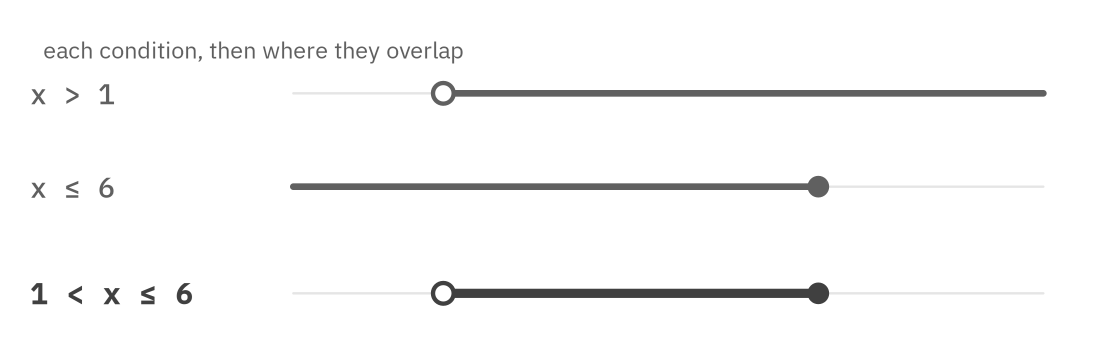
Figure 2. An "and" keeps only what both conditions share, the overlap of the two rays. (This picture shows the overlap ; the worked example above overlaps in the same way.)
An "or" points the other way. The solution to " or " is the two outer stretches together, with the middle excluded, a single set made of two pieces. Reading whether a problem wants the overlap or the union is half of getting these right.
Interpret absolute value as distance
A scope note before the technique: absolute value equations and inequalities are grouped here with other inequality skills for teaching flow, but for official score-report purposes the College Board reports absolute value under Advanced Math, not Algebra. If you are tracking domain-by-domain accuracy, log this skill under Advanced Math.
Absolute value is best read as distance before it is treated as algebra, and once you read it that way these inequalities almost solve themselves. The expression is the distance from to on the number line. So a "less than" statement says is close to , and a "greater than" statement says is far from it.
Worked: within. Solve .
This says the distance from to 5 is at most 3, so lies within three units of five, on either side:
A single band centered at 5, reaching from to .
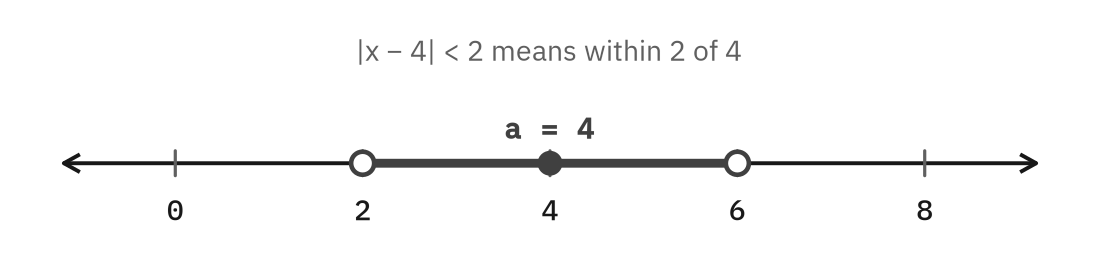
Figure 3. "Less than" is a single band: the points within a fixed distance of the center. (This picture shows , a band centered at 4.)
Worked: beyond. Solve .
Read as , so this is the distance from to , and it must be more than 4. Points that far from split into two rays:
or
Far-from is two pieces reaching outward; close-to is one band between. The direction of the inequality decides which.
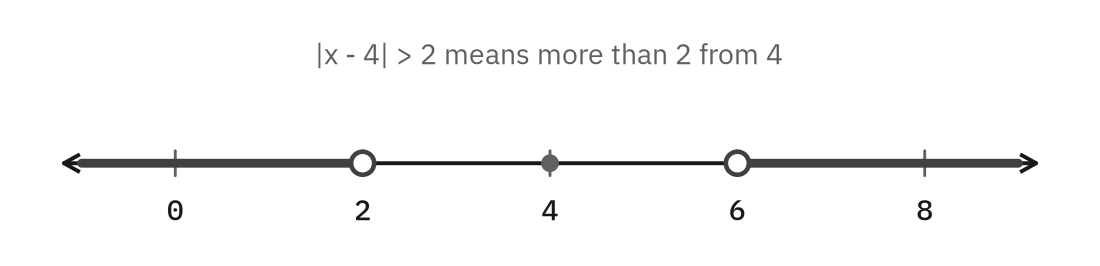
Figure 4. "Greater than" is two rays: the points more than a fixed distance from the center, with the middle excluded. (This picture shows .)
Graph linear inequalities in two variables as half-planes
With two variables, an inequality describes a region of the plane rather than a stretch of the line. The matching equation draws a boundary line, and one whole side of that line is the solution set. Two small conventions complete the picture: a strict inequality draws the boundary dashed to show the line itself is excluded, while "or equal to" draws it solid; and the correct side is settled by testing a single point not on the line.
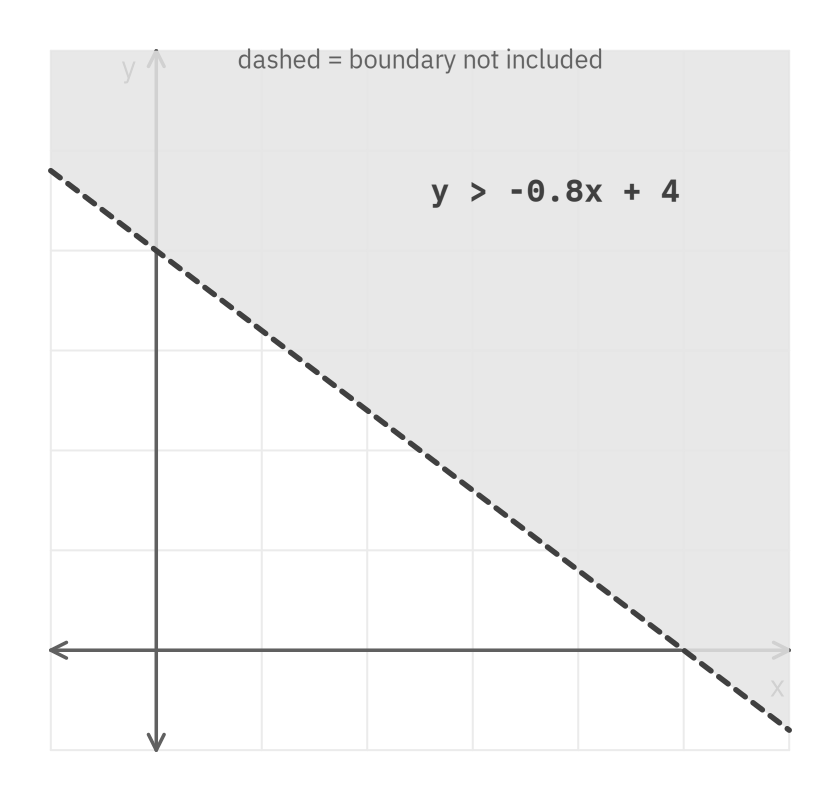
Figure 5. A two-variable inequality is a half-plane. A dashed boundary is excluded; the shaded side is the solution set.
Worked: which side, by testing a point. For , test the easy point : , and is true.
So is in the region, which means the solution is the side of the line containing the origin. One test point settles the whole half-plane.
Find the solution region of a system of inequalities
Several inequalities at once define a feasible region: the set of points satisfying every condition, which is the overlap of all the individual half-planes. A point is a solution to the system exactly when it lives inside all of them, and the most reliable way to test a candidate point is simply to check it against each inequality in turn.
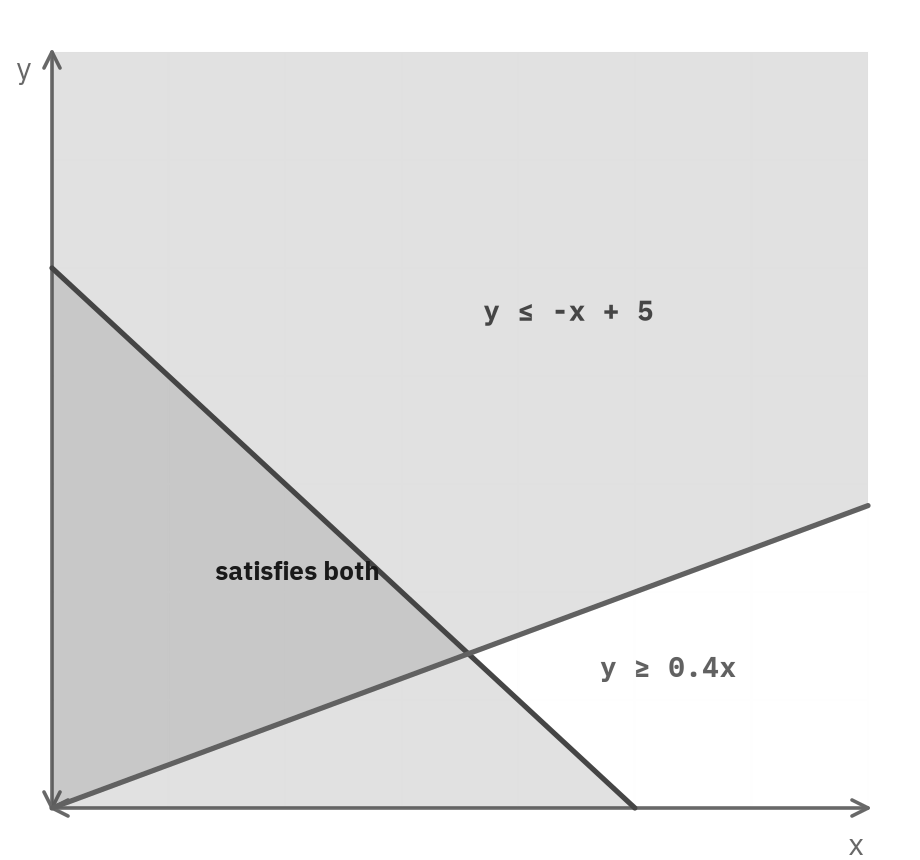
Figure 6. A system's solution is the overlap of its half-planes; the darker region satisfies every inequality.
Worked: testing a point against a system. Is a solution of and ?
Check the first: , that is , true. Check the second: , true.
It satisfies both, so it lies in the feasible region. A point failing either check would be excluded, no matter how well it satisfied the other.
Hand, Desmos, or hybrid? Graphing the inequalities directly shows the feasible region as shaded overlap, which turns a point-by-point check into a single glance: if the candidate point falls in the darker overlapping area, it solves the system. This is especially fast when three or more inequalities are stacked at once, since checking each one by substitution takes longer than reading one picture.
Use linear inequality constraints to find feasible maxima or minima
When a question asks for the greatest or least allowed value, the answer is usually pinned by a boundary the restrictions create, not by some unconstrained extreme. And in a real situation, extra conditions (a count must be a whole number, a length must be positive) tighten the range further, so the largest legal value can sit just inside an edge.
Worked: the greatest whole number that fits. A budget allows , where is a number of items. Solving gives .
But counts items, so it must be a whole number. The largest whole number not exceeding 7.6 is 7.
The algebra set the ceiling; the real-world restriction, whole items, chose the actual answer just beneath it.
Check whether the calculated value satisfies the restrictions
Inequality answer choices frequently separate what is calculated from what is allowed. A value can satisfy the algebra perfectly and still be ruled out by a restriction: a negative length, a fractional count of people, a value outside a stated domain. The correct answer is the one that is both arithmetically right and actually permitted by the situation. When two choices differ only by an endpoint being included or excluded, the question is testing whether you read against ; when a choice is a clean number that violates a stated condition, it is there for the reader who solved but did not check legality.
Chapter summary
Linear inequalities produce solution sets rather than single values. Solve with the usual inverse operations, reverse the inequality when multiplying or dividing by a negative, and read boundaries carefully. For two variables, identify the correct half-plane and overlap of constraints; in context problems, apply integer, positivity, and domain restrictions. Absolute value is taught here for flow but should be logged under Advanced Math.