Systems of two linear equations
A system combines two constraints. The task is to determine what those constraints fix, whether that is a point, a variable, or a requested combination.
You saw in the craft chapters that a single relationship can fix a combination of variables without fixing the variables themselves. A system is where that idea earns the most, because now you hold two relationships at once, and two relationships can do only a few things. They can pin the variables to a single shared point; they can agree so completely that the second adds nothing the first did not already say; or they can contradict each other so that nothing satisfies both. Reading which of these is happening, and extracting exactly what was asked with the least fragile work, is what this unit trains.
Solve systems by elimination or substitution
Elimination and substitution are two standard routes. Choose the one that extracts the requested information with the least unnecessary work. Substitution shines when one variable is already alone, or nearly so: you replace it and collapse two equations into one.
Worked: by substitution. Solve and . The first equation already gives alone, so substitute it into the second.
Then . The solution is the single pair .
Elimination shines when the coefficients already line up, or can be scaled to line up: you add or subtract the equations to cancel one variable.
Worked: by elimination. Solve and . The -terms are identical, so subtracting removes outright.
Back-substitute: , so and . The solution is .
Choose the route after you have seen what the question wants. If it asks for a single variable, or for a combination, you may not need the full solution at all, which is the next idea.
Hand, Desmos, or hybrid? A system with awkward-looking coefficients is a strong Desmos candidate: graph both equations and click the intersection, and both and are read off directly with no elimination arithmetic at all. Clean, small-integer coefficients are usually just as fast by hand; the messier the numbers, the more the graph route pays off.
Use linear combinations to find a requested expression
Often the requested quantity is a combination of the variables, and a combination can be assembled straight from the two equations without ever finding and separately. The cleanest move is to look at the target first and ask whether adding, subtracting, or scaling the equations produces it directly.
Worked: assemble the target by adding. Given and , find .
Add the two equations and the requested combination simply appears:
No coordinate pair was needed. This avoids unnecessary algebra and reduces opportunities for sign errors.
Sometimes the target needs a little scaling before it falls out. To find alone from and , scale the first equation by 3 so the -terms cancel on adding:
, then , so .
But do not force a combination that does not fit. If the target does not line up cleanly with the equations, scaling them into knots is more fragile than simply solving the system the ordinary way. The judgment is one quick test: can the target be built directly? If yes, build it; if no, solve enough and no more.
Classify systems as one solution, no solution, or infinitely many
When a system is solved fully, the result is one of three outcomes, and each is the same statement told twice: once in algebra, once in geometry. Two independent equations meet at a single shared point: one solution.
Worked: one solution. Solve and . Add to remove :
, then .
The lines cross exactly once, at .
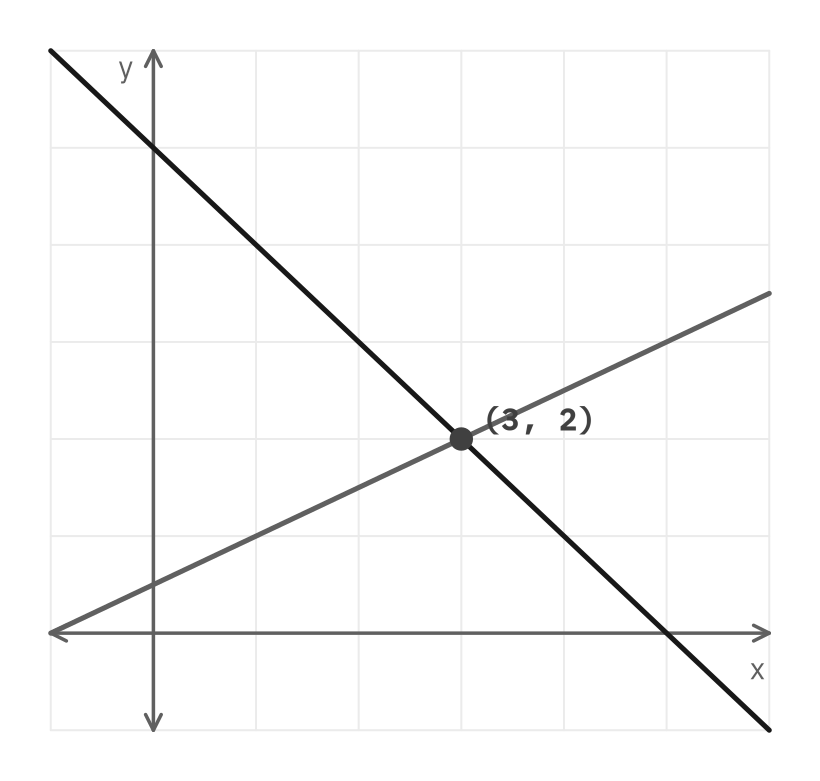
Figure 1. Independent equations cross at a single point, so exactly one pair satisfies both. (This picture shows a different pair of lines that cross at ; the idea is identical.)
Two equations describing parallel lines never meet: no solution. In algebra this shows up as the same left-side combination being assigned two different values, the larger cousin of the contradiction you met when a single equation's variable cancelled.
Worked: no solution. Take and . Double the first equation to compare:
, but the second says .
The same combination cannot equal both 8 and 9, so nothing satisfies both. The lines are parallel.
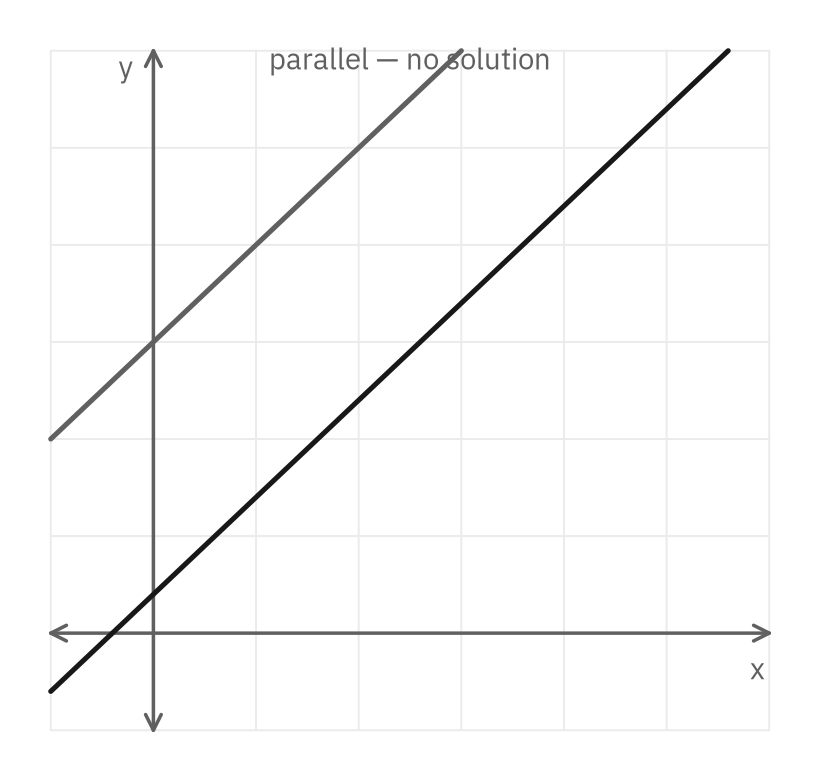
Figure 2. Parallel lines never intersect: one combination is asked to equal two different numbers.
And two equations that are secretly the same line agree everywhere: infinitely many solutions. Here the second equation is just a scaled copy of the first, adding no new restriction.
Worked: infinitely many solutions. Take and . The second is exactly twice the first.
Eliminating gives : a statement that is always true, which is the system reporting that the two equations carry one fact between them.
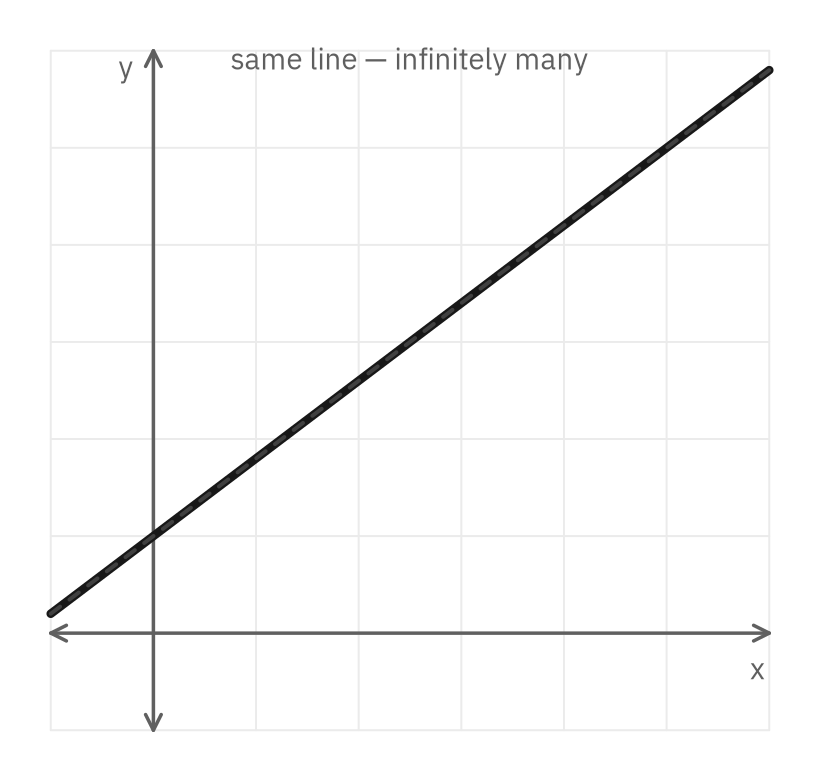
Figure 3. One line drawn twice: every point on it satisfies both equations.
This gives a clean reading rule. Eliminate a variable and look at what is left: a value for the remaining variable means one solution; a true statement with no variable, like , means infinitely many; a false statement, like , means none. You never have to graph anything to tell them apart.
The three system outcomes
Lines cross once: one solution, and elimination leaves a value.
Lines are parallel: no solution, and elimination leaves a false statement.
Lines coincide: infinitely many solutions, and elimination leaves a true statement.
Find a constant that creates one, no, or infinitely many solutions
When a letter sits among the coefficients, it is usually not another variable to solve for; it selects which of the three outcomes the system has. The reading is structural: if the parameter makes the variable terms proportional, the constants then decide between no solution and infinitely many; if it leaves them non-proportional, the system has exactly one solution.
Worked: choosing a parameter for no solution. For what value of does and have no solution?
No solution needs the left sides proportional but the constants out of step. The -coefficients 4 and 8 are in ratio , so the -coefficients must match that ratio:
.
Check the constants at : the first equation is , while half of the second is . The same combination is assigned two values, so there is no solution, exactly what was wanted.
Notice the half-step that is easy to skip: matching the coefficient ratio is necessary but not the end. Had the constants also matched that ratio, the very same would have produced infinitely many solutions instead. The parameter sets the slopes equal; the constants decide whether the two lines are parallel or identical.
Create and interpret systems from context
A word problem usually hands you two facts about two quantities, and asks for one quantity, a total, or a difference. Translate each fact into an equation, then choose the lightest route to the thing requested.
Worked: a concession stand. Popcorn costs $4 and a drink costs $3. One afternoon the stand sold 50 items for $172. How many drinks were sold?
Let be popcorns and be drinks. The two facts are a count and a total:
and
Substitute into the total: , so and (with ).
Both counts are whole and nonnegative, so the answer fits the situation: 28 drinks.
Worked: reading both coordinates of an intersection. Shipping plan A costs $20 plus $3 per pound; plan B costs $10 plus $5 per pound. At what weight do the two plans cost the same, and what is that shared cost?
Set the two cost expressions equal and solve for the weight:
The intersection is a point, not just an -value, and the question asked about both of its coordinates. The weight is 5 pounds; the shared cost is . Reporting only is incomplete because the question asks for both the weight and the shared cost, represented by the point .
That last check is not a formality. A real-world system carries restrictions the algebra does not know about: counts must be whole and nonnegative, lengths must be positive, a probability must sit between zero and one. If the algebra ever returns a value that the situation cannot hold, first rule out a setup or arithmetic error before drawing a conclusion; only after ruling out an error does the situation itself have no valid answer, and recognizing that is part of what the question is testing.
Use answer choices to check the target
System answer choices are usually built from the levels of information the question is sorting through. If the target is , the choices often include , , , and the ordered pair: each a true by-product of correct work, only one of them the requested object. If the target is a parameter that gives no solution, expect the value that instead gives infinitely many to be sitting right beside it. The familiar-looking answer is frequently an honest intermediate value, not the thing that was asked. Use the answer choices as a final target check, but report only the quantity named in the stem.
Chapter summary
Two linear equations can intersect once, coincide, or be parallel. Elimination identifies the outcome quickly, and a requested linear combination can often be obtained without solving for both variables. Parameters control whether coefficients and constants become proportional. In context problems, check that the resulting values satisfy the stated restrictions.