Pacing two 35-minute Math modules
Three forces decide whether your knowledge becomes your score: how you spend your time, the order in which you spend it, and whether you answer the question that was actually asked.
This final section gathers the habits that convert what you know into what you earn, and they are the habits, not the mathematics, that separate two equally capable test-takers. Three forces are at work. Pacing governs how your minutes are spent, triage governs the order you spend them in, and accuracy governs whether a solved question actually scores. A lapse in any one quietly drains points that your preparation already won, which is why the strongest scorers treat these as deliberately as they treat the algebra. None of it is difficult; all of it is a matter of habit, built before test day so that on the day it runs by itself.
Spend time unevenly as question difficulty rises
Twenty-two questions in 35 minutes averages about 95 seconds each, but average is the key word. The questions are not equal: an early routine one may take 30 seconds, while a layered one near the end deserves two minutes or more. So the budget is not a metronome ticking the same interval for every question; it is a pool of time to spend unevenly on purpose. The goal is to finish the easy questions fast enough to bank extra minutes, then pour those minutes into the few hard questions that need them. Pacing well means moving quickly where you can so you can move slowly where it counts.
Use a forward first pass and targeted return within each module
The cleanest way to spend that pool is in passes. On the first pass, sweep through the module and answer every question you can do quickly and confidently, flagging, with the mark-for-review tool, anything that would cost you real time. This banks a large block of points fast and leaves you a precise list of what remains. On the second pass, return to the flagged questions with the time you saved, now free to think hard without the pressure of unseen questions ahead. A final, brief sweep makes sure nothing is left blank.
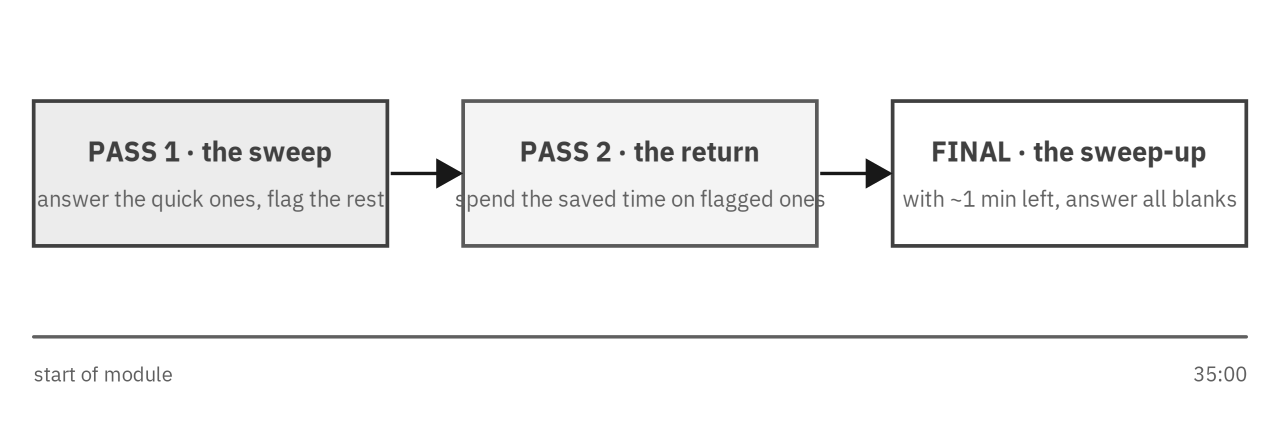
Figure 1. Spend the module in passes: bank the quick questions first, return to the flagged ones, then make sure nothing is left blank.
Decide when to move on from a question
The discipline that makes the two-pass approach work is letting go of a stuck question. When a problem has resisted you for a minute and a half or so with no path in sight, flag it and move on, not because you cannot do it, but because the minutes it is consuming would earn more points spent on the questions still ahead. Do not spend several minutes protecting one uncertain question while easier, attainable questions remain unseen. The scoring model is not a simple equal-points-per-question system, but unreached attainable questions still waste opportunities. The hardest moment of pacing is abandoning a question you feel you almost have; train yourself to do it anyway, knowing you can return on the second pass with fresh eyes.
Classify marked questions by what remains to be done
A mark-for-review flag is only useful if it tells your later self something. “I did not like this one” is not information; it just defers the problem. Before you flag a question, name, in one word, why:
- Nearly solved: needing only one more calculation or a target check.
- Route known: the setup was right but the execution ran long.
- Two-choice: a single targeted check or a Desmos entry would settle it.
- A different route: you already see a faster method but spent your patience on the first one.
- No route: the question never became mathematically clear at all.
That one word decides your second pass. Return to nearly-solved and route-known questions first, since a small amount of time turns them directly into points. Two-choice and different-route questions come next, since a specific action closes each one. No-route questions wait for whatever time is left; sinking your last minutes into a question that never opened up costs more than it can pay back.
Use the final five minutes to answer remaining questions first
When the five-minute warning appears, do not start a fresh pass through the whole module. Run this sequence instead. First, scan for anything genuinely unanswered and put a plausible answer on it; a blank costs the same as a miss, but a guess can only help. Second, return to your nearly-solved and route-known flags, in that order, since they convert fastest. Third, if time remains, spend it on one targeted check, a quick Desmos entry or a single substitution, on a two-choice flag. A no-route question waits until everything else is covered; do not let one of them absorb minutes that could have secured several easier questions instead.
Treat correct-but-slow questions as pacing errors
A question you eventually solved correctly can still be a pacing failure, if it cost you the time two or three easier questions needed. Treat correct-but-slow as its own category worth reviewing, the same way you would review a wrong answer, and ask what actually cost the time: did you not recognize the governing idea quickly, was the method valid but roundabout, did Desmos help or slow you down, was the arithmetic itself the drag, or did you check work you had no specific reason to doubt? Naming the real cause is what turns a slow question into a fixable habit instead of a mystery.
Recognize a late cluster of hard questions for what it is
Time loss is not always one expensive question; several hard or long items can arrive back to back, especially later in a module, and the effect compounds in a way a single slow question does not. Each one alone might be manageable, but three in a row can consume the reserve that easier questions earlier were supposed to build. The mechanism worth naming is different from ordinary correct-but-slow review: it is not one habit to fix, but a run of genuinely harder material landing together.
When this happens, triage across the whole cluster rather than solving each question in the order it appears. Skim all of the remaining flagged or unattempted questions first, mark which ones have a visible route and which do not, and work the visible-route ones before committing time to any question where the first move is still unclear. A cluster rewards sequencing; treating it as a strict left-to-right march is what turns three hard questions into three rushed guesses.
The moment right after a long question is where pacing damage compounds, or stops. The instinct to rush the next few questions to make up time is the wrong one; it trades one slow question for several rushed, error-prone ones. The better response is to return to your normal pace immediately and tighten your exit point on the next question that resists you. And if you know, from your own timed practice, roughly how much reserve your last several questions tend to need, protect that reserve on purpose rather than discovering the shortfall in the moment.
Answer all 22 questions before the module closes
One rule sits above the pacing arithmetic, because the test imposes no penalty for a wrong answer: a blank and a wrong answer both score zero, so an unanswered question is pure waste. The final sweep exists for exactly this. With about a minute left in the module, put a plausible answer on every multiple-choice question you have not reached, then return to think if any seconds remain. None of those guesses can cost you a thing, and a few of them will land, free points that a blank would have thrown away.
Check the exact quantity before moving on
Now the single most common avoidable error on the whole test, and the one most worth drilling: solving the problem correctly and then giving the wrong quantity. A question sets up an equation in but asks for ; it gives you two roots but wants their sum; it asks for the area when you have just found the radius. The mathematics was right; the answer was wrong, because the final step, reading what was actually requested, was skipped. The cure is a habit: before you commit an answer, re-read the last line of the question and confirm the number you are about to give is the exact quantity it names.
Worked example: solve, then answer what was asked. If , what is the value of ?
Solving gives , so , and it is tempting to enter 5, the value you just found.
But the question asked for , which is .
The whole error was answering the question you solved instead of the question that was asked. Re-reading the last line catches it every time.
Run a targeted final check: sign, units, restriction, or entry
A few more slips account for most forfeited points among people who know the material, and naming them is half of avoiding them. Sign errors creep in when distributing a negative or moving a term across an equals sign; slow down for that single step. Transcription errors copy a number wrong from the screen to your work or from your work to the box; read it back once. Calculator-entry errors mistype an expression; glance at what you actually entered. And unit slips answer in the wrong units, giving feet when the question wanted inches. Each is caught by a half-second of attention at exactly the spot it tends to occur, and your review minutes are best spent on flagged questions and on these checkpoints, not on re-deriving easy questions you already trust.
Pacing and accuracy checklist
Spend time unevenly: go fast on the easy questions to bank minutes for the hard ones.
First pass: answer everything quick; flag the rest with mark-for-review.
Second pass: return to flagged questions with the saved time.
Cut it short: stuck past about ninety seconds, flag and move on.
Final sweep: with a minute left, put an answer on every blank; nothing is deducted.
Before you commit: re-read the last line and answer the exact quantity asked.
Guard the slips: signs, transcription, calculator entry, and units.
Practice: Math pacing
The practice set for this unit is deliberately mixed for pacing practice rather than ordered exactly like a real SAT module. On the real SAT, questions within a Math module are arranged from easier to harder overall. Here, the mixed order forces you to practice identifying a quick route, flagging a slow item, and returning under a short timer. Set a timer for 12 minutes and work the whole set as you would a real module: bank the quick ones, flag anything that resists you, and do not let one question take more than its share. When the timer ends, stop, even if a question is unfinished, then move to the classification step that follows.
Classify errors and slow solutions after timed practice
Checking right and wrong is scorekeeping, not review. For each of the nine questions, sort your own result into one of five categories, using your memory of how the attempt actually went, not just whether the number matches.
- Correct, fast: right answer, and it came quickly. Nothing to fix here.
- Correct, slow: right answer, but it cost more time than it should have. Name why: an idea you were slow to recognize, a roundabout method, or arithmetic that dragged.
- Wrong route: the setup itself was off, the wrong equation, the wrong relationship, before any arithmetic went wrong.
- Wrong execution: the setup was right, but a sign, a step, or the final answered quantity slipped along the way.
- Unanswered: the timer ended before you reached or finished it.
A pattern in the tally is the actual output of this exercise. Several correct, slow marks point to pacing habits to tighten. Wrong route points to content still worth a closer look. And an unanswered question 9 while question 7 ate the clock is itself the lesson: the deliberately hard question was exactly the one to flag and leave.
Math pacing: summary
Three habits turn knowledge into points. Pace by spending unevenly (fast on the easy, slow on the hard) and run the module in passes: bank the quick questions, flag and return to the slow ones, and let go of anything that stalls you past about ninety seconds. Leave nothing blank, since a guess never costs and sometimes scores. And answer the question that was asked: re-read its last line, give the exact quantity it names, and guard the small slips in signs, transcription, calculator entry, and units. These cost nothing in knowledge and secure everything you know.
Execution review: tools, adaptivity, response entry, and pacing
That closes the Execution part, and with it, the instruction of this book. You now hold not only the four domains of the test's mathematics but the discipline to deploy them under real conditions: the Desmos calculator as a problem-solving engine, the adaptive format understood and used on purpose, substitution as a faster road when algebra resists, the grid-in rules made automatic, and pacing, triage, and accuracy turned into habit. The four principles that opened this part (use the tools, take the cheapest path, leave nothing blank, answer exactly what was asked) are now yours to apply. What remains is practice: the diagnostic, the targeted mastery and transfer work, and the benchmark test ahead exist to make every habit in these pages reflexive, so that on test day your knowledge arrives intact, and fully spent, on the page.